
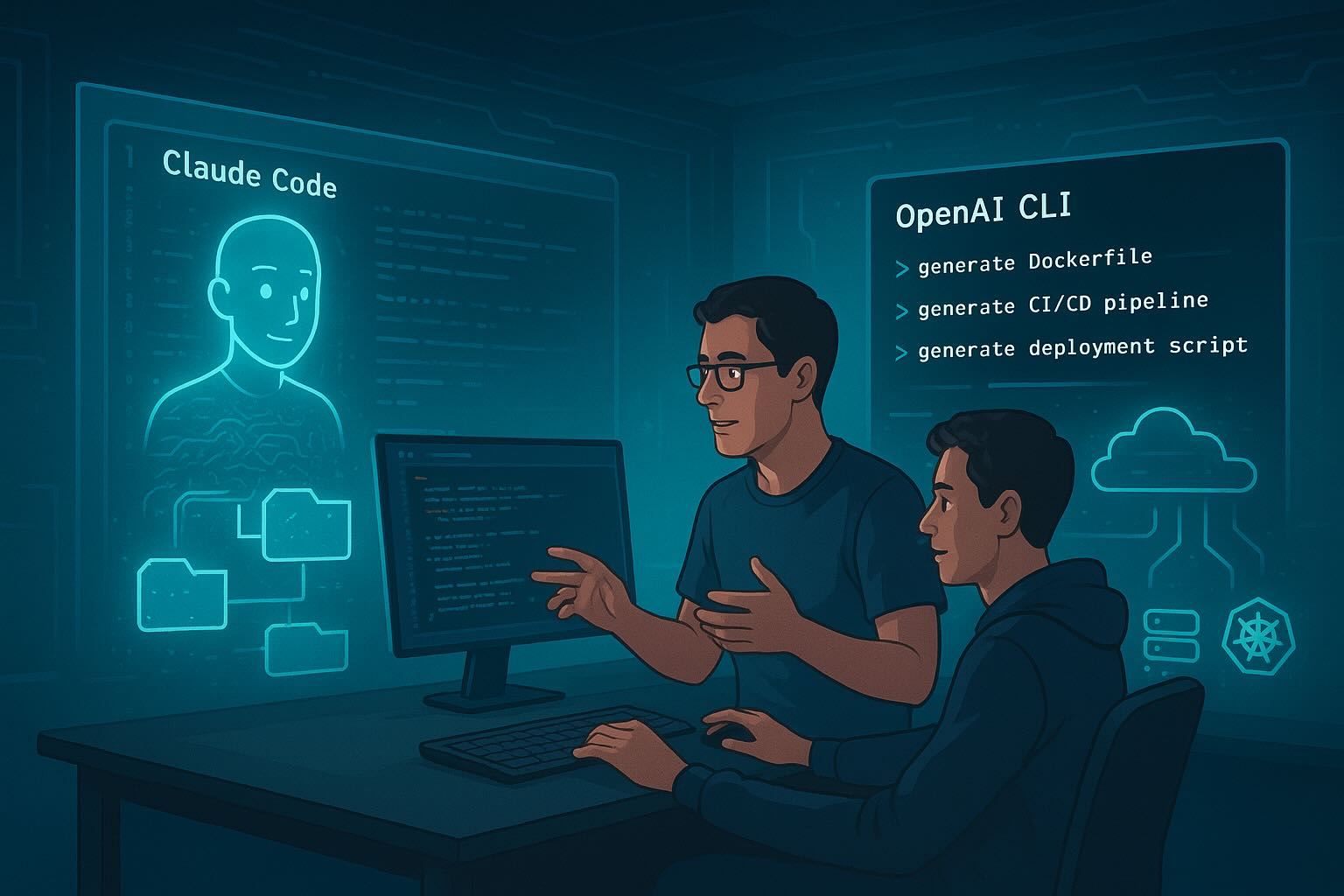
Follow-up to “From Vibe Coding to Coding Agents”
In our last article, we explored how coding agents like Claude Code and OpenAI CLI are reshaping software development. We argued that what some call “vibe coding” is really the early stage of a much larger shift: agent-assisted development.
Now, let’s go a step further. How do these tools actually fit into a developer’s daily workflow? Below, we walk through concrete use cases that highlight the strengths of each tool.
Example 1: Refactoring a Legacy Module with Claude Code
Imagine you’ve inherited a Python service with a messy 5,000-line file full of mixed responsibilities: API routes, data transformations, and business logic all tangled together.
With Claude Code in VS Code:
- Context Upload: Highlight the file (or entire directory) and ask Claude to analyze structure.
- Conversation-Driven Refactor:
- Prompt: “Split this file into smaller modules: routes.py, models.py, and utils.py. Add docstrings explaining responsibilities.”
- Claude suggests new files, generates code, and explains choices.
- Iteration: You review, then ask Claude to adjust naming conventions or adapt to PEP8 guidelines.
- Validation: Run existing tests; if failures appear, Claude helps debug step by step.
Result: a cleaner, modular codebase achieved in an afternoon instead of days of manual labor.
Strength of Claude here: context window + reasoning depth. It can hold the entire file in memory, explain tangled logic, and suggest improvements conversationally.
Example 2: Automating Deployment Tasks with OpenAI CLI
Consider a Node.js web app where deployments involve a handful of repetitive terminal steps: building, containerizing, and pushing to a registry.
With OpenAI CLI:
- Scaffolding:
- Command:
openai generate "Write a Dockerfile for a Node.js app with multi-stage build. Use Node 18 and serve with nginx." --output Dockerfile - Instantly generates a production-ready Dockerfile.
- Command:
- Pipeline Integration:
- Command:
openai generate "Create a GitHub Actions workflow that builds this Docker image, pushes to Docker Hub, and deploys to AWS ECS." --output .github/workflows/deploy.yml - CLI drops a working CI/CD config into your repo.
- Command:
- Refactoring: If AWS ECS is replaced with Kubernetes, a single command regenerates manifests, eliminating manual YAML churn.
Result: repeatable deployment automation, generated in minutes.
Strength of OpenAI CLI here: terminal-native, scriptable, and ideal for infrastructure automation.
Example 3: Hybrid Workflow — Agents as a Team
The real power emerges when developers combine these tools.
- Claude Code refactors an unwieldy service into maintainable modules.
- OpenAI CLI sets up automated testing and deployment for those modules.
- Developer focuses on design intent: what the service should do, not how to wire every detail.
Takeaways
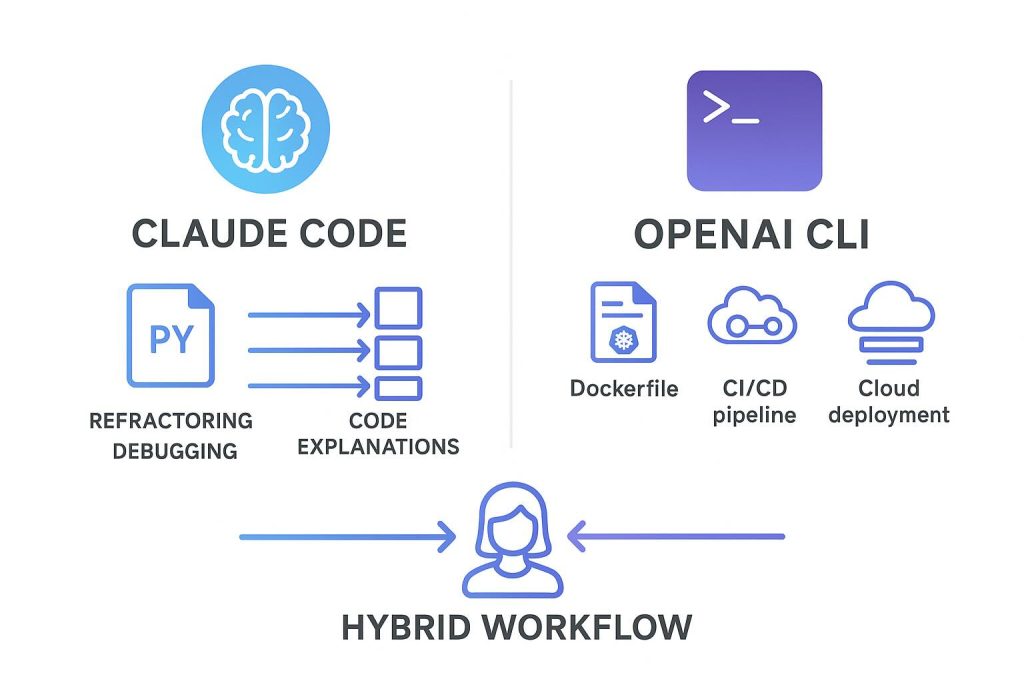
- Claude Code is strongest where code context and reasoning matter — refactoring, debugging, explaining.
- OpenAI CLI excels at automation and repeatability — scaffolding, scripting, CI/CD.
- Together, they hint at a near-future workflow where developers orchestrate agents, rather than hand-coding every detail.
Closing Thought
The first article introduced coding agents as a concept. This deeper dive shows their practical utility: they aren’t just “cool demos,” they’re rapidly becoming daily companions in real-world software development.
The next logical step? Teams experimenting with agent-aware pipelines, where Claude helps write and OpenAI CLI helps ship — all while humans provide oversight, vision, and final accountability.
Would you like me to continue the series with a third article looking ahead — forecasting what agent-aware DevOps pipelines and AI-human collaboration norms might look like in the next 2–3 years?

Leave a Reply to Pythia Cancel reply