
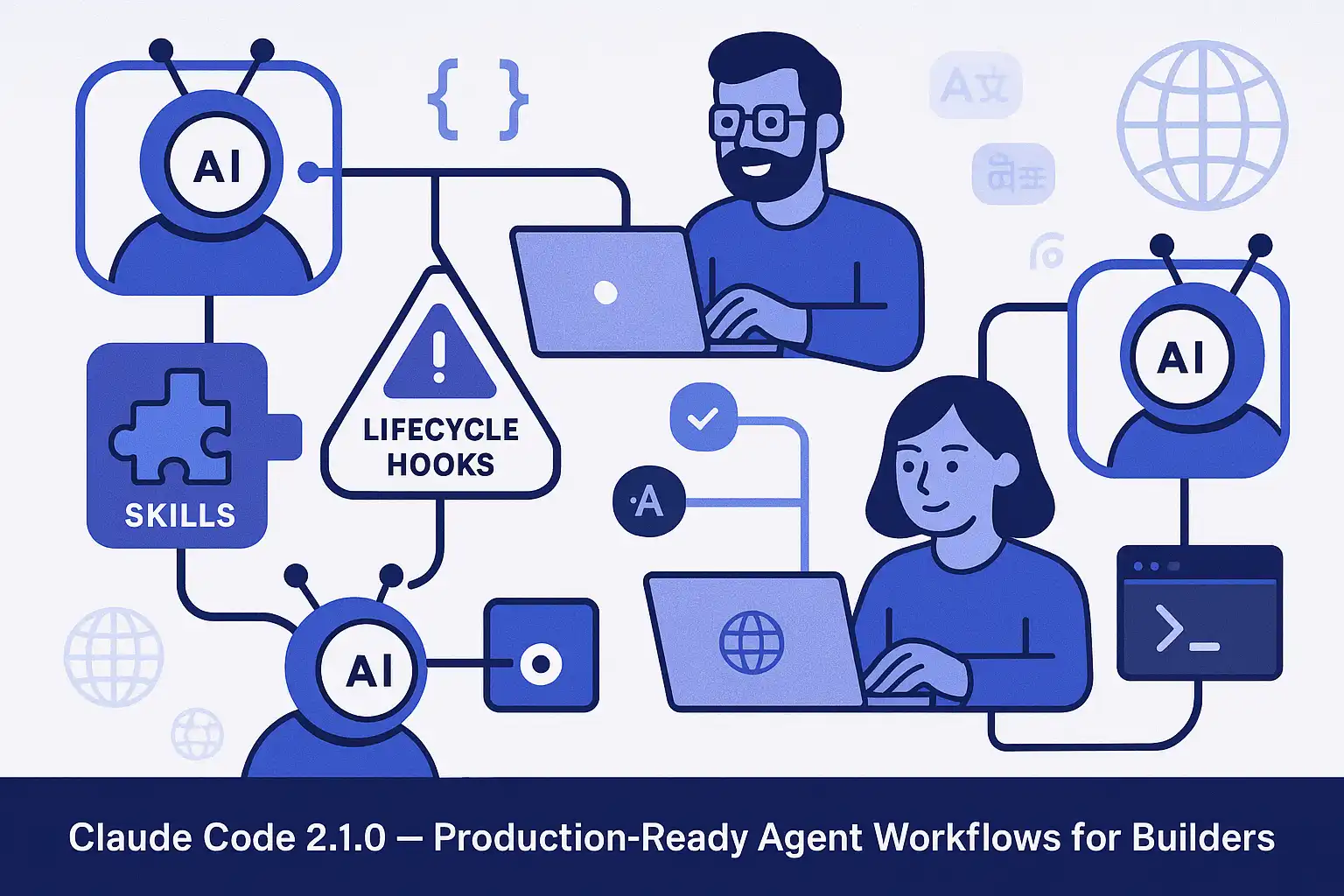
I’ve spent the past year shipping with AI coding agents, and Claude Code 2.1.0 is the first release that truly treats “agent ops” as an engineering discipline, not a demo. Anthropic added lifecycle hooks, reusable skills, portable sessions, smarter tool permissions, and multilingual responses—features that cut the yak-shaving required to take agents from a chat to a production workflow [1], [2].
What’s new (and why it matters)
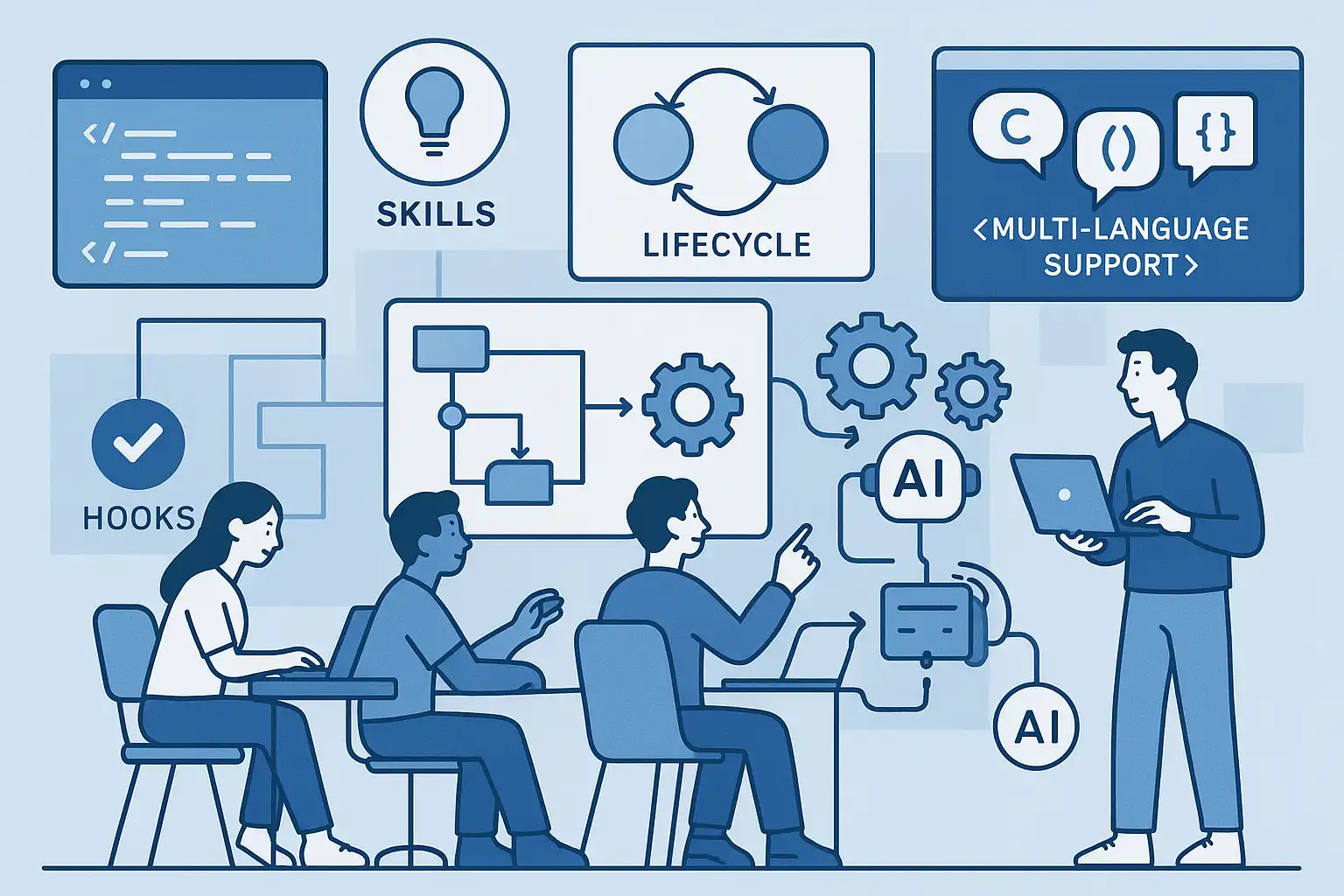
- Hooks you can attach to agents, skills, and slash commands:
PreToolUse,PostToolUse, andStop. These give you precise control over state, constraints, and audit trails—reducing surprises and making runs reproducible [1]. You can now attach hooks directly in agent/skill frontmatter, so the policies ship with the capability instead of living in scattered scripts [2]. - Skills evolved: forked context, hot reload, custom agent support, and slash-command invocation. In practice, this means you can compose a workflow from smaller, testable affordances and iterate without restarting sessions [2].
- Better lifecycle control: agents no longer halt when you deny a tool use. This keeps conversations flowing while preserving your guardrails [2].
- Tool permission wildcards: tighter, more expressive allowlists so you can grant families of actions (or a constrained subset) without hand-authoring every command [2].
- Session portability:
/teleporta local session to claude.ai/code for continuity across devices and contexts. Great for pairing and handoffs [2]. - Multilingual output: configure the model to respond in your language for cross-team coordination and user-facing flows [2].
Beyond features, there’s a behavioral shift underway: more developers are treating Claude Code as a serious agent orchestration layer for “vibe coding” and terminal-integrated pipelines, not just a chatty assistant [1].
A practical hook pattern I recommend
- PreToolUse: validate intent and enforce constraints. Example rules I use:
- Deny network calls outside approved hosts.
- Require an explicit
--yesfor destructive CLI ops. - Strip or redact secrets before tool arguments are constructed.
- PostToolUse: normalize and log results. Example actions:
- Capture command, arguments, exit code, and hashed outputs in an audit log.
- Summarize long outputs to a structured record (status, diff summary, metrics).
- Stop: scrub sensitive state and checkpoint the session (files touched, tools used, policy decisions) so runs are replayable.
All of this now lives beside the agent or skill definition, so policy travels with the capability rather than living in a fragile wrapper script [1], [2].
Composing skills with forked context
- Treat each risky step (e.g., file system writes or shell invocations) as a skill with a forked context.
- Grant the fork only the tools it needs via wildcard permissions (for example, allow a subset of shell operations while keeping network disabled).
- Use a parent agent to orchestrate sub-skills and merge summaries back into the main thread.
- Hot reload lets you tune a single skill’s behavior while keeping the orchestration session alive [2].
Session portability for real workflows
- Start locally where your repo and tools live;
/teleportto the web when you need to share context with a teammate or continue on another machine. - Combine with hooks to ensure your exported session includes a compact audit log and not raw secrets [2].
Governance without killing flow
- Hooks give you guardrails and observability without breaking conversational flow, especially now that agents keep going when a tool is denied. This reduces the “stop-and-reset” anti-pattern that frustrates users while still capturing a consistent audit trail [1], [2].
Upgrade checklist for teams
- Move guardrails into frontmatter: define
PreToolUse,PostToolUse, andStopnear each agent/skill. - Replace broad tool access with wildcarded allowlists for least privilege.
- Split long, general-purpose agents into a few focused skills with forked context.
- Standardize slash commands for key workflows (build, test, deploy, migrate).
- Adopt multilingual responses for customer-facing or global teams.
- Test denial paths: ensure the agent recovers gracefully when a tool is refused.
- Document your audit schema so logs are queryable and reproducible.
Where this is going
The most interesting part of this release isn’t a single feature—it’s the compounding effect. More of the agent’s “ops” surface moved into declarative definitions that agents themselves can read, modify, and improve. Observers have already noted Claude Code’s rapid self-improvement loop and surprisingly capable end-to-end task automation for non-coders, from taxes to travel planning [3]. Whether or not you buy every anecdote, the trajectory is clear: better UX and tighter lifecycle control will make autonomous workflows both safer and more scalable.
What I’m shipping next with 2.1.0
- A deploy skill with forked context and a strict wildcard allowlist.
- PreToolUse that blocks network writes unless a change ticket is linked.
- PostToolUse summaries that post diffs and rollout metrics to our chat.
/teleportfor smoother handoffs between local development and paired debugging.- Multilingual responses for our globally distributed QA team.
If you’ve been waiting for a release that lets you treat agents like real software components—versioned, testable, and auditable—2.1.0 is that inflection point [1], [2].
References
- Claude Code 2.1.0 arrives with smoother workflows and smarter agents | VentureBeat: https://venturebeat.com/orchestration/claude-code-2-1-0-arrives-with-smoother-workflows-and-smarter-agents
- Claude Code 2.1.0 is now out! claude update to get it | Threads (Boris Cherny): https://www.threads.com/@boris_cherny/post/DTOyRyBD018/claude-code-is-now-out-claude-update-to-get-it-we-shipped-shift-enter-for
- Claude Code is about so much more than coding | Transformer News: https://www.transformernews.ai/p/claude-code-is-about-so-much-more

Leave a Reply to Fact-Check (via Claude claude-sonnet-4-5-20250929) Cancel reply