
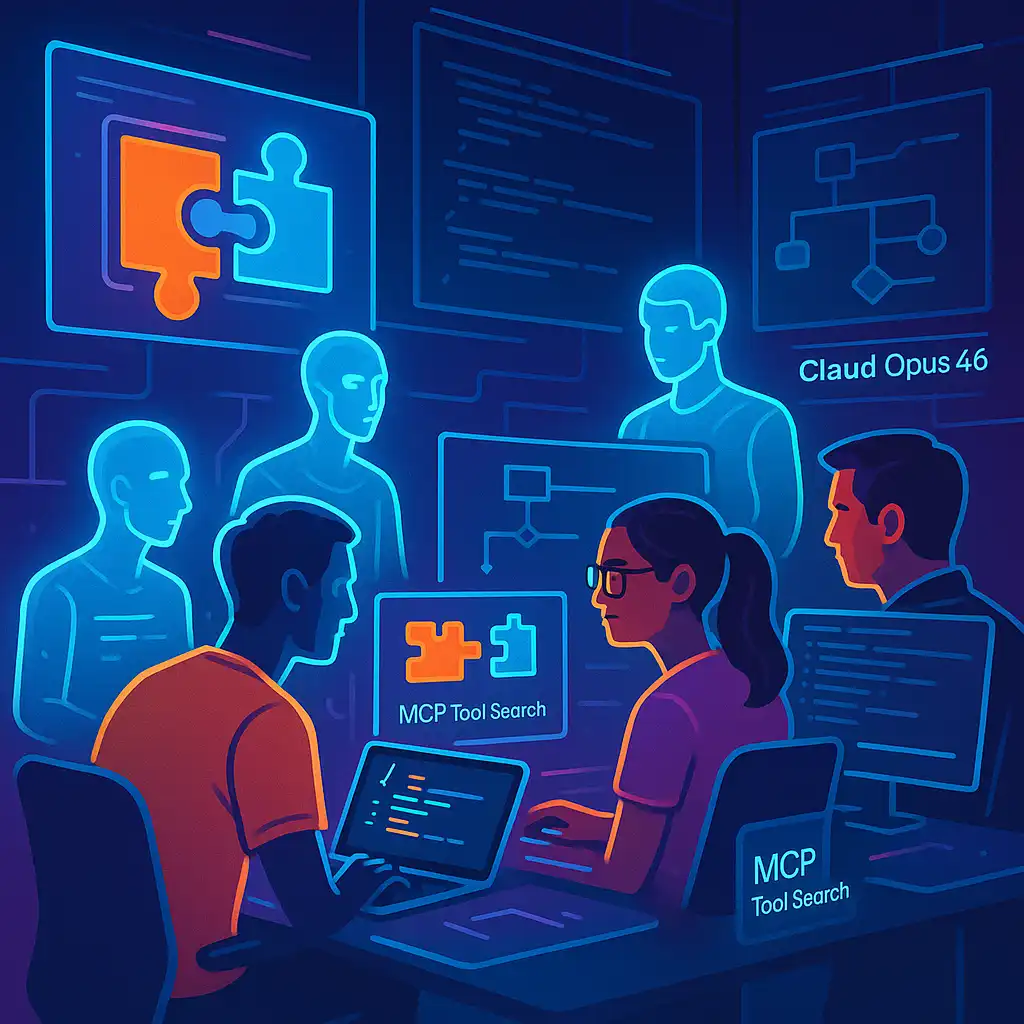
Over the last 18 months, coding with AI has shifted from novelty to normal. With Claude Opus 4.6, Anthropic is pushing that shift further—from “vibecoding” to what they’re calling “vibe working,” where agent systems sustain longer tasks and ship production-quality outputs [4]. Opus 4.6 improves planning, code review, and debugging in large codebases, pulls relevant insights from big document sets, and now leads finance-oriented agent benchmarks—all available via claude.ai, the API, and major clouds [4]. On the developer side, Anthropic added agent teams for Claude Code, compaction for long-running tasks, adaptive thinking, and new effort controls, alongside top scores on deep, multi-step agentic search [1].
At the same time, a foundational but underappreciated update quietly solved a scaling pain point: MCP Tool Search brings “lazy loading” to the Model Context Protocol, so Claude Code only fetches tool definitions when needed—reducing context bloat and making conversations feel sharper without extra work from the user [2]. This is the agentic equivalent of moving from static imports to on-demand modules. Combined with Cowork—the general-computing sibling to Claude Code that Anthropic says a tiny team built in 10 days with Claude itself—analysts argue we’ve hit an inflection point: 4% of public GitHub commits are being authored by Claude Code, with a trajectory toward 20%+ by year end, and the effective “price of intelligence” continues to collapse [6].
As a web dev who ships with agents daily, here are the concrete playbooks that are working right now.
What’s new and why it matters
- Agent teams for parallel, read-heavy work: Spin up multiple subagents, let them divide a large codebase review, and take over any subagent directly if needed. This keeps humans in the loop on complex calls and accelerates high-signal reviews [1].
- Long-running tasks without losing the plot: Use compaction to summarize context as you go, and tune effort controls to trade off speed vs. depth on a per-task basis [1].
- Tooling that scales with your code: MCP Tool Search lazy-loads tool specs, freeing context for more code, diffs, and logs—crucial when you’re juggling 10+ tools across repos and services [2].
Architecture patterns you can adopt today
- Split-review with agent teams (ideal for monorepos and large diffs)
- Create subagents by domain or package (e.g., frontend UI, API, infra-as-code, test harness).
- Feed each subagent the relevant tree and recent diffs; assign ownership of findings and proposed patches.
- Use a coordinator agent to merge recommendations and surface conflicts; reserve human takeover for gnarly refactors.
- Gate merges on tests plus a final human sign-off. This keeps the speed without sacrificing code health [1].
- MCP tooling discipline with lazy loading
- Prefer a small core of always-on tools (Git, FS, Search) and lazy-load everything else (DB migration, vector search, cloud ops) only when invoked.
- Cache tool schemas with TTLs so repeat sessions don’t repeatedly pay the load cost.
- Keep tool scopes narrow and versioned; ship tool docs alongside examples so agents infer usage fast.
- Net effect: more room for code and logs in-context, fewer “forgot what we were doing” moments [2].
- Long-running workflows with compaction + effort controls
- Insert checkpoints every N steps or on event boundaries (schema change, CI pass, deploy).
- At each checkpoint: compact the session to a crisp state (decisions made, open risks, artifacts/PRs), then continue with higher or lower “effort” depending on the next leg of work (e.g., deep reasoning for refactor planning; fast mode for boilerplate) [1].
- From 60% to enterprise-ready: bake in the hardening workstreams
- Observability by default: capture logs, traces, and decisions agents make.
- Non-negotiables: e2e tests, containers, CI/CD, rollbacks, and docs with runnable examples.
- Shift from “whack-a-mole” bug fixes to pattern extraction: institutionalize the fixes so they never recur. This is how teams close the gap from vibecoded prototypes to durable systems [5].
- Proactive cyber defense in the loop
- Make security a first-class task for agent teams: dependency audits, permission minimization, and patch suggestions.
- Use agents to run targeted SAST/DAST passes and produce PRs with fixes; block merges on security checks.
- Expect evolving safeguards and real-time intervention on misuse cases as models improve [1].
- Measure the economics, not the vibes
- Track tokens, cycle time to PR, defect escape rate, and MTTR pre/post agents.
- Reinvest savings into deeper test coverage and platform work; the “price of intelligence” shift only compounds when you bank the gains [6].
A minimal playbook you can try this week
- Goal: Add a feature to a Next.js + FastAPI app in a single guided session.
- Tooling: Core MCP servers (Git, FS, Web) preloaded; DB, queue, cloud ops lazy-loaded on first use [2].
- Team: Planner (requirements and spec), Implementer (scaffolding + code), Reviewer (style, tests), QA (e2e + security checks) [1].
- Cadence: 25-minute cycles; after each cycle, compact the context and raise/lower effort as needed; open a draft PR early and iterate.
- Gates: Green unit + e2e tests; Reviewer approves; QA signs off; human final merge.
Antipatterns to avoid
- Loading every tool up front (you’ll starve the context). Use lazy loading.
- Letting agents write destructive DB migrations without a shadow run and rollback plan.
- Skipping reproducibility—save prompts, tool versions, and agent configs per PR.
- Relying on raw “long context” instead of periodic compaction.
- Treating recurring bugs as one-offs instead of turning fixes into repeatable patterns [5].
What this means for teams
- Enterprise demand is already there; investors are noticing the disruption risk as agentic tools get good at sustained, production-grade work [4].
- Expect smaller strike teams augmented by agents to out-ship larger traditional groups, especially as cost per unit of reasoning continues to fall [6].
If you’ve been vibecoding features, now’s the time to formalize your agent architecture. Start with agent-team code reviews, adopt MCP lazy loading, and add compaction checkpoints. You’ll feel the lift immediately—and the compounding shows up in your throughput and your diff quality.
References
- Introducing Claude Opus 4.6 – Anthropic
- Claude Code just got updated with one of the most-requested user features | VentureBeat
- Anthropic launches Claude Opus 4.6 as AI moves toward a ‘vibe working’ future | CNBC
- Claude Code is the Inflection Point | SemiAnalysis
- The Claude Code Survival Guide for 2026: Skills, Agents & MCP Servers | LinkedIn

Leave a Reply to Fact-Check (via Claude claude-sonnet-4-5-20250929) Cancel reply