
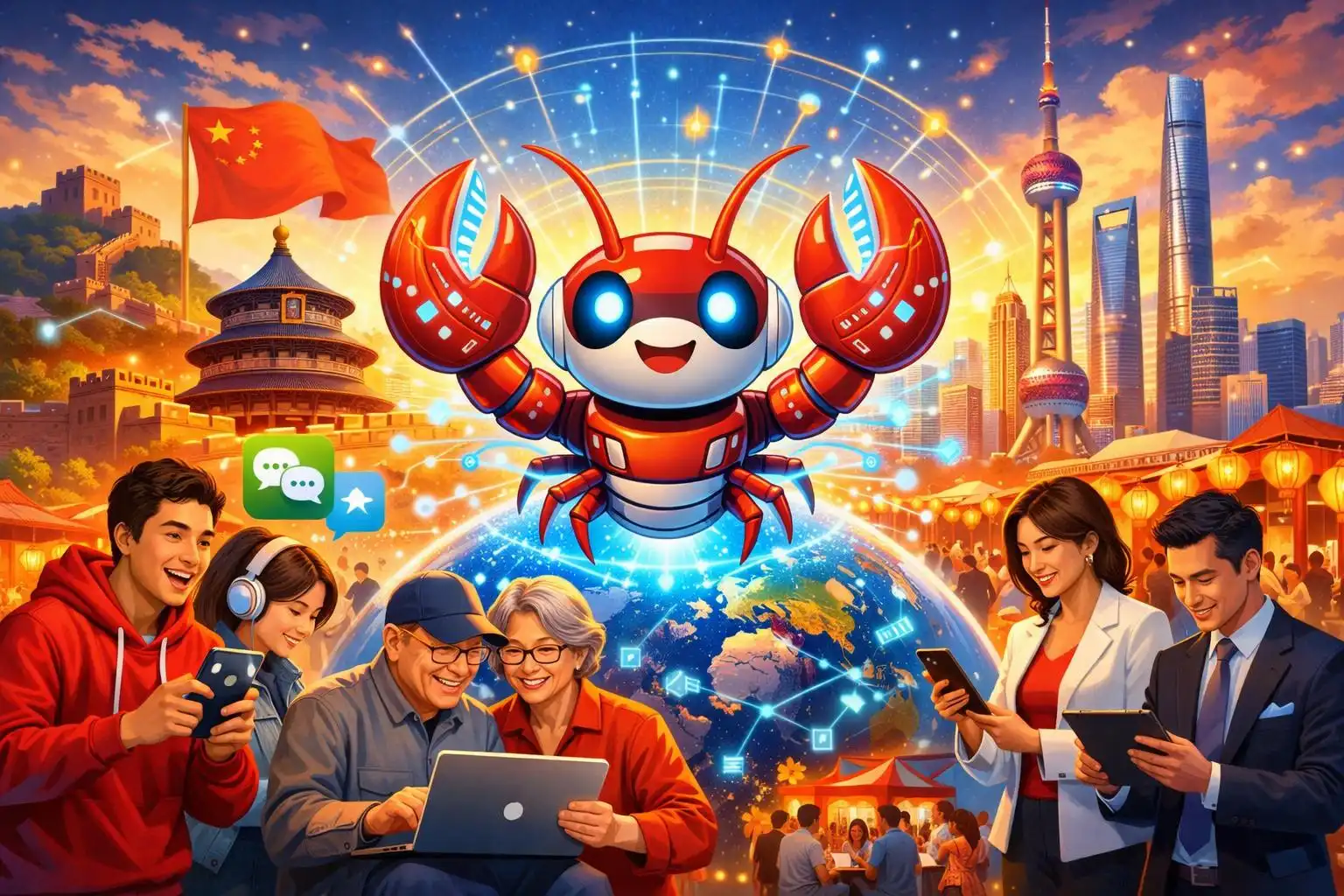

When Nvidia CEO Jensen Huang declared OpenClaw “definitely the next ChatGPT” at the company’s GTC event in March 2026[1], he wasn’t just making a bold prediction—he was observing a phenomenon already reshaping how millions of people interact with artificial intelligence. And nowhere is this transformation more visible than in China, where OpenClaw adoption has exploded beyond the tech community into mainstream culture.
From Vienna to Beijing: OpenClaw’s Unexpected Journey
OpenClaw, developed by Austrian developer Peter Steinberger (who joined OpenAI in mid-February 2026[2]), represents a fundamental shift in AI technology. Unlike traditional chatbots that simply respond to questions, OpenClaw is an autonomous AI agent that can complete tasks, make decisions, and take actions with minimal human guidance. As Huang explained, “In one line of code, you can create for yourself your own agent. Then after that, just ask the agent to do whatever you want.”[1]
What makes OpenClaw particularly powerful is its integration with popular messaging platforms like WhatsApp, Telegram, Discord, and Signal. This allows users to interact with their AI agent through familiar interfaces, sending requests that the agent executes autonomously across multiple applications and services.
China’s “Lobster Buffet”: Mass Adoption at Lightning Speed
While OpenClaw has gained traction globally, China has emerged as the epicenter of the AI agent revolution. According to SecurityScorecard, an American cybersecurity firm, China has already surpassed the United States in OpenClaw adoption[5]—a remarkable achievement for a tool that only launched in November 2025.
The Chinese tech ecosystem has embraced OpenClaw with extraordinary enthusiasm. Chinese users have playfully dubbed the process of setting up OpenClaw as “raising a lobster,” referencing the tool’s crustacean-themed branding. This cultural phenomenon has spawned countless meetups, installation events, and community gatherings across the country.
“It seems everyone around me – my colleagues and friends — has it,” said Gong Sheng, a new user waiting to get set up at a Baidu-hosted event in Beijing. “I don’t want to be left behind.”[5]
Tech Giants Lower the Barriers
One of OpenClaw’s initial challenges was its complex installation process, which posed significant hurdles for non-technical users. Chinese technology companies have aggressively addressed this limitation, transforming OpenClaw from a developer tool into a consumer-friendly product.
Tencent launched a comprehensive suite of AI products built on OpenClaw, branded as “lobster special forces” and integrated with WeChat, China’s ubiquitous super-app[2]. The same week, startup Zhipu AI released its own localized OpenClaw version featuring over 50 pre-installed skills available through “one-click installation.”
Baidu and Tencent have gone even further, organizing public events specifically designed to help everyday people—from tech enthusiasts to retirees—get OpenClaw installed on their devices. These gatherings attract hundreds of attendees eager to join what many see as the next wave of technological transformation.
The Economic Advantage: Chinese AI Models Power OpenClaw
China’s OpenClaw adoption has been supercharged by the country’s rapidly advancing AI model ecosystem. According to OpenRouter, a startup offering developers access to AI models, the top three tools used by OpenClaw users on its marketplace are all from Chinese companies, with combined usage double that of Google Gemini and Anthropic Claude models[2].
This preference isn’t just about nationalism—it’s economics. Chinese-made AI models released in 2026 have narrowed the performance gap with U.S. rivals while offering capabilities at a fraction of the cost. Since OpenClaw users pay only for the underlying language model usage (the software itself is free), this cost advantage significantly lowers the barrier to entry for Chinese users.
Real-World Impact: The Rise of “One-Person Companies”
The practical applications of OpenClaw are already reshaping how Chinese professionals work. Wang Xiaoyan, one user profiled in recent coverage, is using OpenClaw to launch what’s being called a “one-person company” (OPC)[5]—a business model where AI agents handle tasks that would traditionally require multiple employees.
Koki Xu, who works in the legal field, attended a packed OpenClaw meetup in Beijing, reflecting the tool’s appeal across professional sectors. “OpenClaw has become really hot!” he observed[5].
This democratization of capability is precisely what Nvidia’s Huang envisions. In his GTC keynote, he illustrated OpenClaw’s potential with a kitchen design example: an agent could autonomously study images, learn design tools, iterate on ideas, and refine its output. “Every carpenter can now be an architect. Every plumber will become an architect,” Huang said. “We are going to elevate the capabilities of everyone.”[1]
Privacy and Security: The Critical Questions
As OpenClaw adoption accelerates, important questions about privacy and security have emerged. AI agents require broader access to data and systems than traditional chatbots, raising concerns about how personal information is handled and protected.
Nvidia has responded by announcing NemoClaw, an enterprise-grade version that layers security tools and Nvidia’s software stack on top of OpenClaw[1]. The company is offering these security services for free, recognizing that enterprise adoption depends on robust safeguards.
For privacy-conscious users, OpenClaw’s open-source nature and ability to run locally on personal devices remain significant advantages. Unlike cloud-based AI assistants, OpenClaw users can maintain control over their data and choose which models and services their agents interact with.
The Global Implications
China’s rapid OpenClaw adoption offers a glimpse into AI’s near future worldwide. The phenomenon demonstrates several key insights:
Accessibility matters: When tech companies invest in simplifying installation and providing local support, adoption accelerates dramatically. China’s approach of hosting community events and creating localized versions has proven far more effective than expecting users to navigate complex technical documentation.
Cost drives adoption: The availability of affordable, high-quality AI models is crucial for mass adoption. China’s competitive AI model marketplace has created a sustainable economic model for OpenClaw usage that could be replicated globally.
Cultural adaptation is essential: The “raising a lobster” framing and integration with local platforms like WeChat show how cultural localization can transform a technical tool into a social phenomenon.
Community builds momentum: The proliferation of meetups, installation events, and user communities has created a network effect, where each new user becomes an advocate who brings others into the ecosystem.
What This Means for the Future of Personal AI
As Jerry Chen of Greylock Partners noted, “The buzz around OpenClaw stems from making AI more tangible to a broader audience beyond researchers and technologists.”[3] The question now is whether OpenClaw becomes “the Linux of the market”—a foundational standard that others build upon—or simply the first of many agentic operating systems.
China’s experience suggests that OpenClaw’s open-source nature, combined with its practical utility and growing ecosystem, positions it as more than a passing trend. The tool has transcended its origins as a developer project to become a platform that’s reshaping how millions of people think about AI’s role in their daily lives.
For those of us who have been following OpenClaw’s development since its early days, watching this global expansion—particularly China’s enthusiastic adoption—feels like witnessing a pivotal moment in technology history. The shift from AI as a conversational tool to AI as an autonomous agent isn’t just theoretical anymore. It’s happening right now, and it’s happening faster than almost anyone predicted.
As OpenClaw continues to evolve and spread globally, the lessons from China’s adoption journey will prove invaluable. The combination of technical accessibility, economic viability, cultural adaptation, and community support has created a blueprint for how transformative technologies can move from niche tools to mainstream phenomena.
The lobster has left the tank, and it’s swimming in waters far beyond where anyone initially imagined.
References
- Nvidia CEO Jensen Huang says OpenClaw is ‘definitely the next ChatGPT’
- Lobster buffet: China’s tech firms feast on OpenClaw as companies race to deploy AI agents
- OpenClaw’s ChatGPT moment sparks concern that AI models are becoming commodities
- How China is getting everyone on OpenClaw, from gearheads to grandmas

Leave a Reply
You must be logged in to post a comment.