
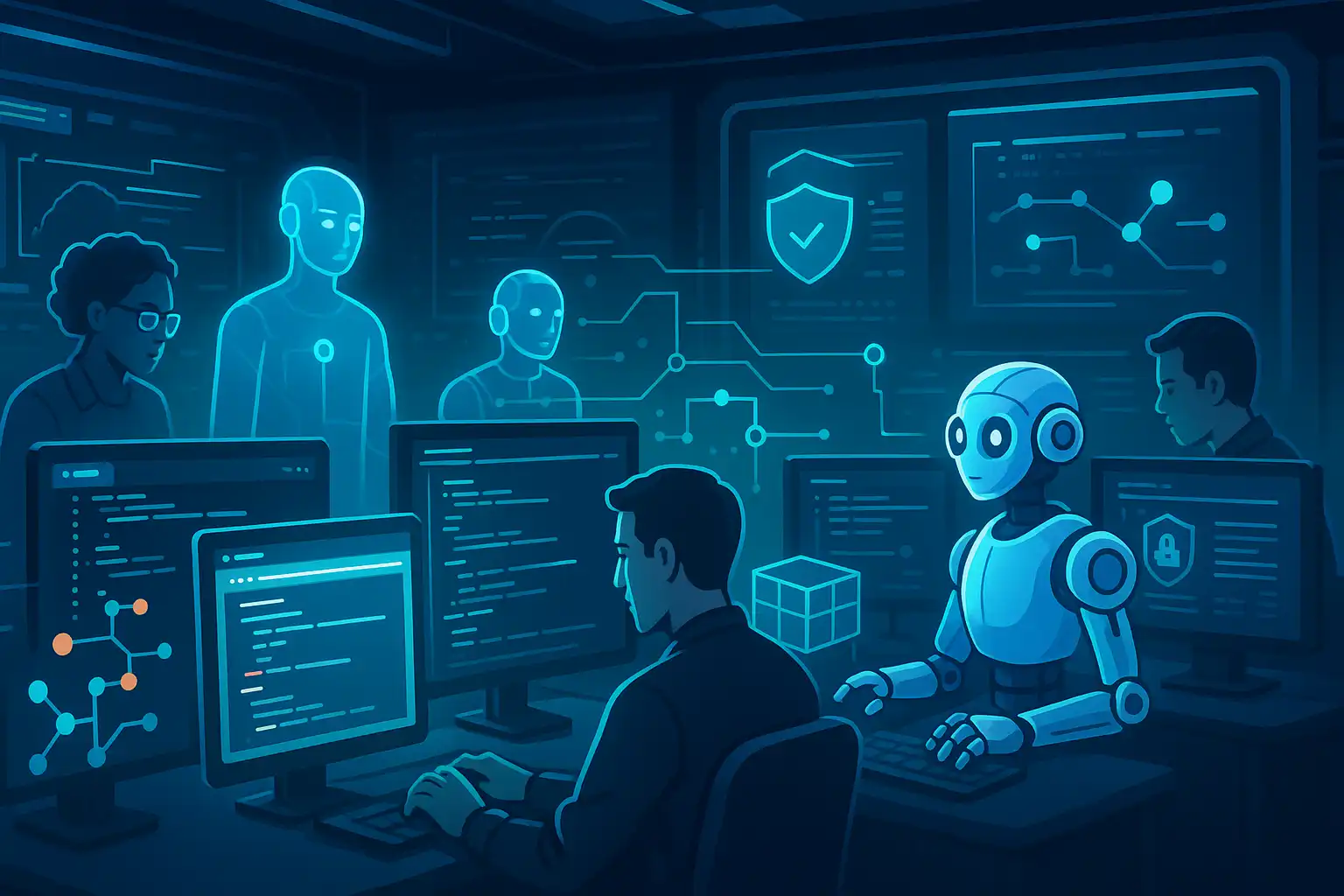

AI coding agents have crossed a threshold: they’re no longer just autocomplete for code—they’re planning, executing, testing, and validating end-to-end features like a small team. Top-tier reasoning models such as GPT-5.2 and Claude Opus 4.5 are being paired with orchestration that routes “hard thinking” to expensive models and simpler work to cheaper ones, a pragmatic split that boosts both quality and cost-efficiency [1].
Meanwhile, the developer surface area is shifting from IDE-only to agentic CLIs and toolchains. Observability vendors are wiring logs, metrics, traces, AI model telemetry, infrastructure, and security signals directly into IDEs and CI/CD, collapsing the feedback loop between agent action, runtime signals, and developer intent [2]. Google’s new Antigravity underscores the pattern: multiple agents collaborate inside the editor, run terminals, and drive browsers to plan work, write code, execute commands, and self-check through live systems interaction—an end-to-end loop that resembles a full dev crew operating within a sandbox [1].
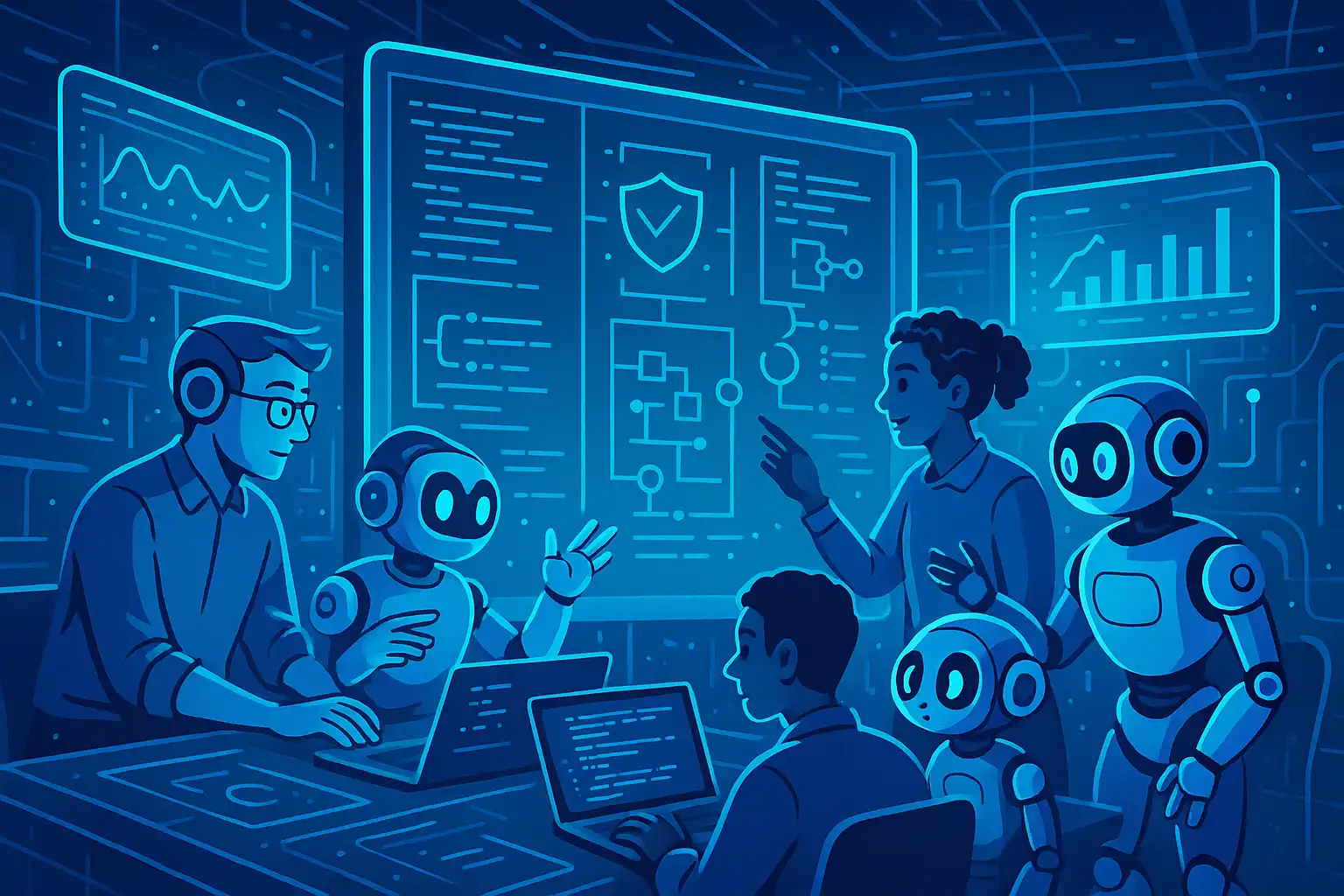
But as agents gain computer-use powers, the blast radius expands. The Month of AI Bugs revealed critical prompt-injection paths leading to zero-click data exfiltration and even remote code execution across multiple vendor products—clear proof that agentic coding assistants must be designed like privileged automation, not friendly chatbots [3].
At the same time, the market is converging on a pattern: don’t chase ever-bigger brains; build a smarter tool ecosystem around a stable model core. The winning setups standardize on orchestration, tools, and guardrails that make agents effective and governable, addressing the otherwise paralyzing sprawl of frameworks and runtimes [8].
Below is my practical blueprint for shipping agentic development safely and at scale in 2026.
Blueprint: a pragmatic agentic dev stack
- Model strategy and routing
- Route complex synthesis, refactors, and reasoning to premium models; offload rote transformations and pattern matching to cheaper models. This “split the thinking” approach is already standard in high-end agent stacks [1].
- Expect fast obsolescence of benchmarks: model providers are curating higher-quality code corpora and shipping rapid improvements, so what’s “SOTA” turns ordinary quickly [4].
- Orchestration and interface
- Prefer CLI-first workflows so agents can run locally or in CI with the same contract; wire tool capabilities (repo ops, terminal, browser, DB, cloud) behind explicit permissions and audit logs.
- Learn from Antigravity’s pattern: multi-agent planning, terminal control, and browser-driven self-checking—replicate with strong sandboxing and ephemeral environments [1].
- Observability as a first-class feature
- Instrument agents like microservices: logs, metrics, spans, prompts, tool calls, model responses, cost, and latency. Unify this telemetry in the IDE and CI/CD to cut feedback cycles during development and incident response [2].
- Security hardening for computer-use agents
- Treat the agent as an untrusted but privileged operator. Enforce:
- Strict tool allowlists and capability scoping (e.g., read-only file operations by default, explicit writes gated by policy).
- Egress controls (DNS and HTTP allowlists) and secrets provenance (no env var leakage to prompts).
- Content sanitization and anti-injection filters on all inbound artifacts (docs, web pages, logs). Assume any page the agent reads can try to exfiltrate.
- Sandboxing with ephemeral workspaces and per-operation credentials.
- This posture directly addresses exploit classes demonstrated across vendors, including zero-click prompt injection and RCE [3].
- Reflection and feedback loops
- Build automatic reflection: agents critique their own outputs with targeted checks (tests run, static analysis, diff review) and iterate. Reflection is one of the most reliable patterns to raise accuracy in practice [6].
- Evaluation you can ship
- Maintain a living golden set of tasks (representative bugs, refactors, migrations) for regression testing of agent behaviors. Golden examples consistently improve in-context performance and give you measurable progress [5].
- If you use MCP-style retrieval and tool graphs, evaluate retrieval quality and tool routing explicitly—bad retrieval quietly sinks agent quality [5].
- Cost engineering and policy
- Set per-run and per-task budgets; log token spend, tool time, and cache hit rates.
- Expect further cost drops but don’t count on them to fix architecture. Some tasks remain expensive; efficient routing and caching materially change your spend curve [4].
What’s new and why it matters
- Multi-agent crews are becoming product defaults. Google’s Antigravity showcases how agents plan, code, run, and verify in one environment—expect more editors and CLIs to do the same [1].
- Tooling is shifting left into the CLI and IDE with deep observability, making agents operationally transparent to developers rather than mysterious boxes in CI [2].
- Security is catching up to capability. The 2025 disclosures should be treated as a baseline threat model for any agent that touches terminals, browsers, or repos [3].
- Don’t overfit to a single frontier model. Industry guidance is coalescing around a stable core plus a curated tool ecosystem; the complexity is real, so frameworks that simplify orchestration and governance are now strategic [8].
- Agents are already outpacing standalone models on practical coding tasks in some benchmarks; vendors are filtering training data for quality, so iteration speed is increasing—not just raw capability but cleanliness of code priors [4].
A minimal reference stack
- Model router: premium reasoning + economical helpers [1].
- Orchestrator/CLI with explicit tools and permission prompts; ephemeral sandboxes.
- Observability: unified traces/logs/metrics plus prompt/response telemetry in IDE and CI [2].
- Security: allowlists, sandboxing, egress control, secret hygiene, artifact sanitization [3].
- Reflection engine and test harness [6].
- Evaluation: golden tasks + retrieval/graph quality checks [5].
- Governance: tool registry, model versioning, cost policies, and incident runbooks [8].
Bottom line
Agent-first development is here. Treat agents like powerful but fallible teammates: instrument them, constrain them, and give them the right tools. If you adopt the blueprint above—routing, orchestration, observability, security, reflection, and evaluation—you’ll ship faster now and be ready when the next wave of models lands.
References
- The AI Models Getting Smarter — Coding Agentic AI News – Week Ending 2025-12-30 (Detailed) — link
- AI Coding Tools in 2025: Welcome to the Agentic CLI Era — The New Stack — link
- Agentic ProbLLMs: Exploiting AI Computer-Use and Coding Agents — 39c3 — link
- Agentic AI Coding: What Still Remains Expensive Amid a 90% Drop … — Belitsoft — link
- 3 Techniques to Effectively Utilize AI Agents for Coding — Towards Data Science — link
- Agentic AI from First Principles: Reflection — Medium — link
- New framework simplifies the complex landscape of agentic AI — VentureBeat — link

Leave a Reply
You must be logged in to post a comment.