
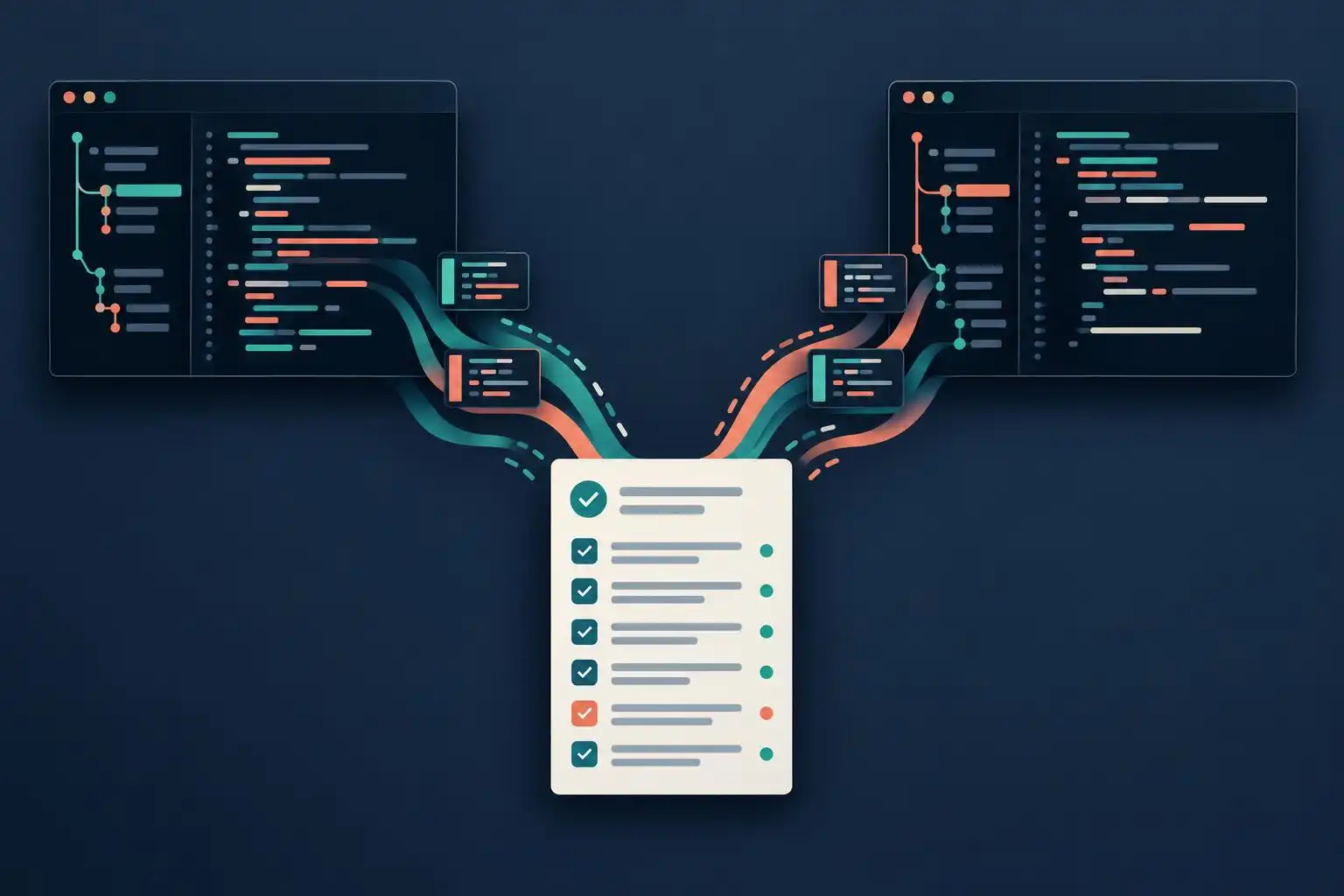

A comparison page can tell you that Claude Code has hooks, Cursor has an AI-native editor, and Codex runs in the terminal. It cannot tell you which one will fix your flaky test without rewriting the surrounding module. One current guide spans eight major tools and their IDE and CLI variants; that breadth is useful for building a shortlist, not choosing a winner.[1]
The better buying question is: What happens when two agents face the same change, in the same repository, under the same permissions? Here is a small bake-off a team can run before committing to seats, usage budgets, or a new editor.

Shortlist by workflow, then stop reading rankings
Start with the environment developers actually use. If the work happens in a terminal or CI job, test a terminal agent. If it depends on navigating and reviewing code in an editor, include an editor-native option. If the team already pays for Claude or ChatGPT, test the coding agent available under that plan before adding another subscription; check the applicable usage limits first.[5]
Keep the shortlist to two or three candidates. A published comparison may call one tool the best for repo-wide work and another the best editor experience, but those are recommendations, not measurements on your codebase.[3] The point of the trial is to replace those labels with evidence you can inspect.
Give every agent the same bounded task
Choose a real, non-urgent issue with a testable outcome: fix a reproducible bug, update an API with a compatibility constraint, or add a narrowly specified feature. Write the acceptance criteria before opening an agent. Include the files or behaviors that must not change, the test command, and whether dependency changes are permitted.
Run each attempt from the same base commit in a separate Git worktree. That avoids one agent inheriting another’s edits. Repeat the first command with a different branch and directory for each candidate:
git worktree add -b trial/agent-a ../trial-agent-a HEAD
cd ../trial-agent-a
git status --short
# Give the agent the shared task brief; do not commit its changes yet.
# Run the repository's documented test command, then inspect:
git diff --check
git diff --stat
git status --short
Do not mistake git diff --stat for a complete audit: it omits untracked files, which is why git status --short is here. Review the patch and run the same tests for every candidate. Keep the prompt, time limit, available documentation, and human assistance comparable; record any intervention instead of quietly rescuing one run.
Score the patch, not the performance of the chat
A persuasive explanation is not a passing test. Use a rubric you can apply to the diff after the session. For example:
- Correctness (35%): Does the change satisfy the acceptance tests and preserve existing behavior?
- Scope (20%): Are edits limited to the requested work, with no gratuitous refactor?
- Security (20%): Did the agent respect permissions and avoid exposing secrets or weakening controls?
- Human time (15%): How much prompting, correction, and review did it require?
- Cost (10%): What did this run consume under the plan and usage policy you would actually buy?
Treat a secret leak or an unauthorized external action as a failure, not a small deduction. Record both elapsed time and hands-on time: a fast agent that needs forty minutes of repair did not save forty minutes. For harder decisions, run a second task of a different type; one bug fix is a screen, not a statistically meaningful leaderboard.
Test reusable instructions separately from model ability
Skills are increasingly presented as portable packages. One platform directory lists project paths for Claude Code, Copilot, Cursor, and Gemini CLI, and says a skill can be copied between supported tools without modification.[2] That is a useful starting hypothesis, not proof that every agent will discover, invoke, and follow your procedure in the same way.
If your team relies on a migration checklist or release procedure, add a second trial: install the same small skill in each platform’s documented project directory. Give the agent a task that should trigger it, then check the resulting actions and artifacts. Score whether it used the procedure correctly—not merely whether the skill file existed. Keep this separate from the baseline task so a configuration mistake does not masquerade as a model-quality result.
Price the operating model you will deploy
Seat prices alone will not settle an enterprise choice. A current enterprise comparison emphasizes governance, where code goes, and usage charges alongside subscription costs.[4] Ask each vendor or administrator how the proposed setup handles repository access, retention, identity, billing visibility, and agent execution. Then compare those answers with the permissions used in your trial.
Report cost as cost per accepted change, including usage charges and review time where you can measure them. A low monthly entry price is attractive, but it is not a bargain if the team cannot predict heavy-agent usage or must maintain an exception-filled approval process. Conversely, a tool that loses the patch-quality round may still be the sensible choice for a restricted repository if its deployment controls fit your requirements.
Key takeaways
- Shortlist agents by where your developers work, not by a universal winner claim.
- Give candidates the same task, base commit, permissions, and acceptance tests.
- Inspect diffs, interventions, security behavior, and total cost—not just the final chat response.
- Trial cross-agent skills and enterprise controls explicitly; neither is proven by a feature checkbox.
References
- AI Coding Tools Comparison Guide — https://github.com/murphye/ai-coding-tools-comparison-guide
- Agent Skills by Platform — Claude Code, Copilot, Cursor & More — https://agentskills.my/platforms
- Best AI Coding Tools in 2026: Claude Code vs Cursor vs GitHub Copilot vs Codex — https://techietory.com/best-ai-coding-tools-2026-claude-code-cursor-copilot-codex
- GitHub Copilot vs Cursor vs Claude Code vs OpenAI Codex: AI Coding Assistants for the Enterprise — https://www.c4cgroup.co.uk/guides/github-copilot-vs-cursor-vs-claude-code-vs-codex
- Claude Code vs Cursor vs OpenAI Codex — https://aixjo.com/compare/claude-code-vs-cursor-vs-codex


Leave a Reply