
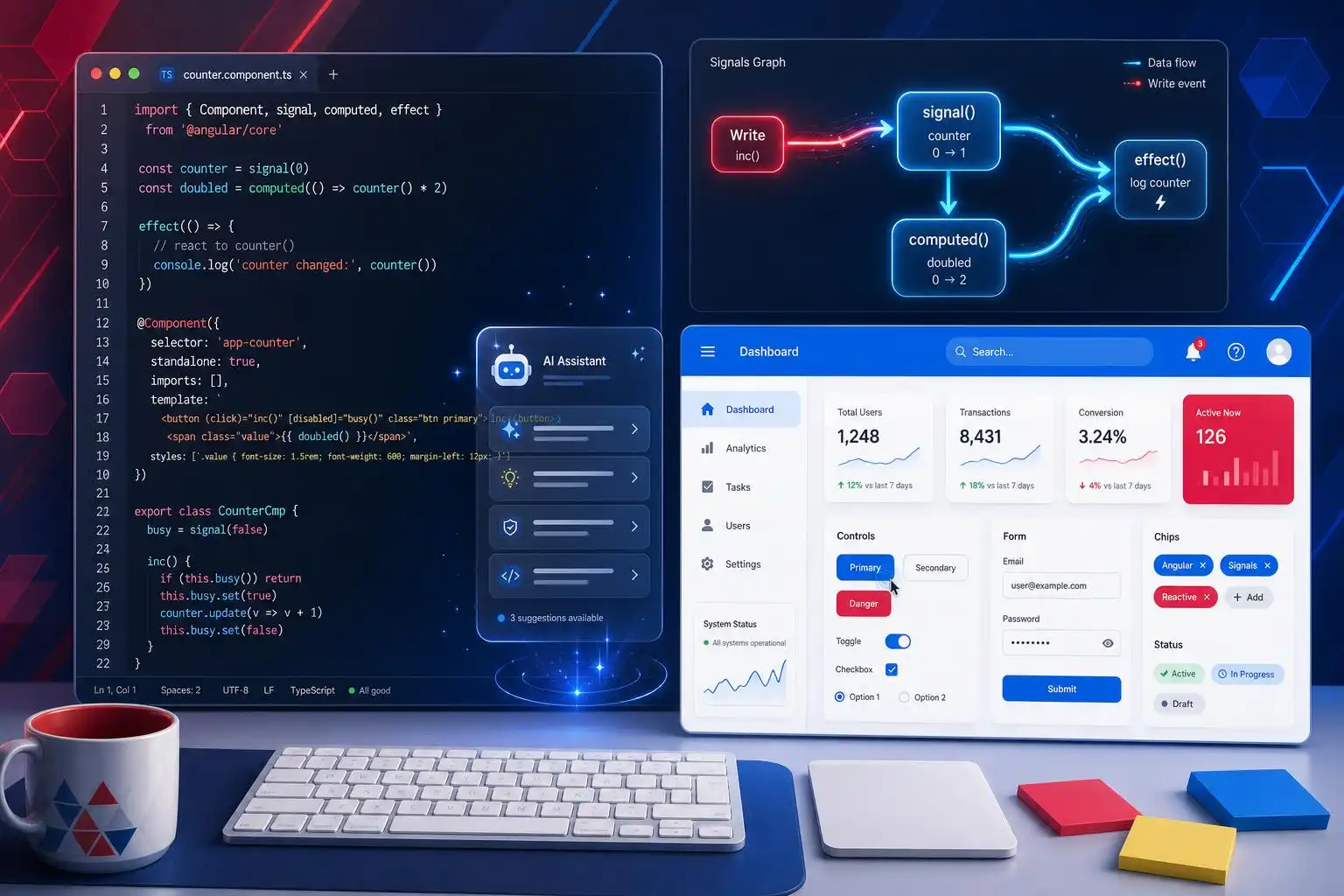

Angular’s 2026 story is no longer just “signals are here.” The more interesting shift is that Angular is becoming opinionated around a complete application model: signal-first state, more predictable change detection, modern forms, stronger dependency injection ergonomics, AI-aware tooling, and a growing ecosystem of community libraries.
That matters because most teams do not modernize one feature at a time. We modernize when the framework, tooling, libraries, and deployment patterns all start pulling in the same direction. Angular 22 appears to be one of those releases.
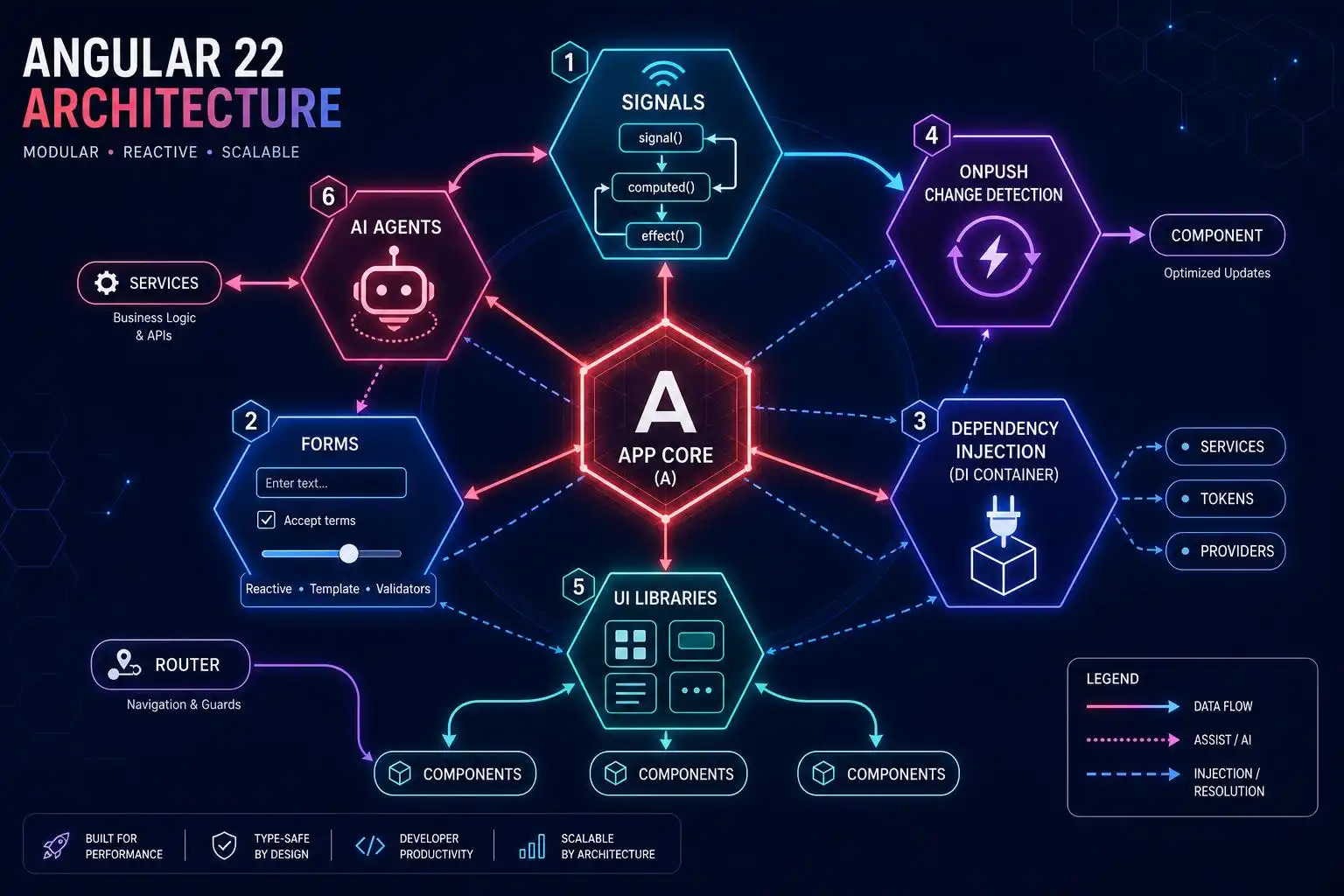
Angular 22 is consolidating the signal-first direction
Recent Angular 22 coverage highlights stable Angular 22 resources, Signal Forms, and new dependency injection APIs such as @Service and injectAsync as headline topics.[1] That combination is worth paying attention to because it touches three everyday parts of Angular development:
- How we model local and shared state
- How we build and validate forms
- How we organize injectable application logic
Signals have already changed how many Angular developers think about reactivity. Instead of leaning on broad component checks and manually managing observable subscriptions everywhere, we can represent state directly and let Angular track dependencies more precisely.
Signal Forms are especially interesting because forms have traditionally been one of Angular’s most powerful but also most verbose areas. Reactive Forms are battle-tested, but they were designed in an older reactive era. A signal-native forms API gives Angular a chance to make form state easier to inspect, compose, and bind without losing the discipline developers expect from Angular.
The practical takeaway: if you are starting a new Angular 22 project, it is time to think of signals as part of the default architecture, not as a side feature.
OnPush as the default changes the performance conversation
One of the biggest reported Angular 22 shifts is that OnPush change detection has become the default, making performant, zoneless-friendly applications feel less like a special configuration and more like the baseline.[5]
For years, I have recommended OnPush for most production Angular components. The reason is simple: it encourages clearer data flow. Inputs matter. Events matter. Observable emissions matter. Signals matter. Random mutation buried deep in an object graph becomes less acceptable.
If OnPush is now the default mental model, Angular developers should tighten up a few habits:
// Prefer replacing state rather than mutating nested objects in place.
profile.update(current => ({
  ...current,
  displayName: newName,
}));
That style works well with signals, component inputs, memoized derived state, and more predictable rendering.
This does not mean every application instantly becomes faster. Poorly structured state can still create unnecessary work. But it does mean Angular is nudging teams toward patterns that scale better: immutable updates where appropriate, smaller components, explicit dependencies, and less reliance on global change detection safety nets.
Dependency injection is becoming more expressive
Angular’s dependency injection has always been one of its strongest features. What is changing now is the ergonomics.
The reported Angular 22 discussion around APIs like @Service and injectAsync suggests a continued effort to make services easier to declare and asynchronous dependency patterns easier to model.[1]
That is important because modern Angular applications increasingly depend on runtime configuration, feature flags, authentication state, remote schemas, and AI-assisted workflows. Not everything is available synchronously at construction time.
A cleaner async injection story could reduce some of the awkward bootstrapping code teams write today. It also fits with Angular’s broader trend: less framework ceremony, more direct expression of intent.
AI is becoming part of the Angular application surface
The Angular team’s discussion of A2UI — making AI agents “speak UI” inside applications — points to a future where AI agents are not just external coding assistants, but participants in the product experience itself.[3]
This is a subtle but important distinction. A chatbot bolted onto a web app is one thing. An agent that understands application actions, UI structure, permissions, and user intent is something else entirely.
For Angular developers, this raises architectural questions:
- Which UI actions are safe for an agent to invoke?
- How should components expose capabilities?
- Can the agent explain what it is about to do?
- How do we preserve accessibility and user control?
- Where do permissions live: in components, services, route guards, or policy layers?
Angular is well-positioned for this because Angular applications are already structured around components, dependency injection, routing, guards, services, and typed APIs. If A2UI-style patterns mature, Angular’s explicit architecture could become a real advantage.
There is also movement on the tooling side. Recent newsletter coverage noted Angular’s official Agent Skills, intended to help AI coding tools write more modern Angular.[4] That is exactly the kind of thing Angular needs in the AI coding era. Generic AI tools often produce outdated Angular code: unnecessary NgModules, older structural directive patterns, manual subscription handling, or code that ignores signals and standalone APIs. Framework-aware guidance helps close that gap.
The community ecosystem is also modernizing
Framework releases matter, but Angular’s long-term health also depends on its surrounding ecosystem. The OpenNG Foundation and spartan/ui 1.0 have recently been highlighted as major community developments, with OpenNG becoming a home for libraries such as Spectator and Elf, and spartan/ui continuing to mature as a UI option.[2]
This is encouraging. Angular has sometimes been perceived as having a smaller community-library culture than React, even though Angular has many high-quality tools. A visible foundation and polished UI libraries help teams feel more confident choosing Angular for new work.
For enterprise teams, ecosystem maturity is not just about shiny components. It is about maintenance, governance, compatibility, testing utilities, state management options, accessibility, and long-term trust.
What I would do in a real Angular 22 project
If I were modernizing an Angular application today, I would not try to rewrite everything at once. I would use Angular 22 as a chance to gradually align the codebase with the direction the framework is clearly taking.
1. Prefer standalone, signal-friendly components
New components should be standalone by default, small enough to reason about, and designed around explicit inputs and outputs. Where local state is needed, signals are often the simplest tool.
@Component({
  selector: 'app-counter',
  standalone: true,
  template: `
    <button type="button" (click)="decrement()">-</button>
    <span>{{ count() }}</span>
    <button type="button" (click)="increment()">+</button>
  `,
})
export class CounterComponent {
  readonly count = signal(0);

  increment() {
    this.count.update(value => value + 1);
  }

  decrement() {
    this.count.update(value => value - 1);
  }
}
2. Treat forms as a modernization target
Forms are often where legacy complexity hides. As Signal Forms mature, they are a natural candidate for new features, internal tools, and isolated refactors. I would not immediately replace every Reactive Form in a large app, but I would start evaluating Signal Forms where the benefits are obvious: dynamic validation, derived form state, conditional fields, and complex UI feedback.
3. Audit mutation patterns before relying on default performance wins
If your application mutates objects in place and expects Angular to notice everything, a more OnPush-oriented world will expose those assumptions quickly. That is not a bad thing. It is a useful forcing function.
Look for patterns like this:
// Risky in modern Angular architectures
this.user.settings.theme = 'dark';
Prefer this:
this.user.update(user => ({
  ...user,
  settings: {
    ...user.settings,
    theme: 'dark',
  },
}));
4. Make services thinner and more intentional
Angular services should not become dumping grounds. With DI ergonomics continuing to evolve, it is a good time to separate responsibilities:
- API clients fetch data
- Stores manage state
- Facades coordinate workflows
- Guards protect routes
- Components render and handle local interaction
This structure also makes AI-assisted development safer because the codebase has clearer boundaries.
5. Prepare for AI-aware UX
Even if you are not building agentic features yet, start thinking about your UI in terms of actions and permissions. An AI agent should not be allowed to “click around” as an uncontrolled user. It should interact through well-defined capabilities.
For example, a future-friendly Angular app might expose actions through typed services rather than burying all behavior inside component templates. That way, whether an action is triggered by a user click, keyboard shortcut, command palette, or AI agent, the same authorization and validation rules apply.
The bigger picture
Angular 22 feels like a convergence release. Signals are influencing forms. OnPush aligns with zoneless performance goals. Dependency injection continues to become more ergonomic. AI is entering both the developer workflow and the application experience. Community projects are getting more organized and polished.
For developers, the message is clear: modern Angular is not just Angular with a few new APIs. It is a more reactive, more explicit, more toolable platform.
That is good news. Angular’s strength has always been that it gives teams a full application framework rather than a pile of disconnected choices. In 2026, that full-framework advantage may become even more valuable — especially as applications become more interactive, more AI-assisted, and more demanding from a performance perspective.
References
- Ng-News 26/15: Angular 22 – Medium — https://medium.com/ng-news/ng-news-26-15-angular-22-bede85702109
- Ng-News 26/16: OpenNG Foundation, spartan/ui – DEV Community — https://dev.to/playfulprogramming-angular/ng-news-2616-openng-foundation-spartanui-1aim
- Demystifying A2UI: How to Make AI Agents “Speak UI” in Your App — https://blog.angular.dev/demystifying-a2ui-how-to-make-ai-agents-speak-ui-in-your-app-e1ffea2303bd
- #64: The Next.js and React.js Weekly Newsletter (17 Jun 2026) — https://officialrajdeepsingh.medium.com/64-the-next-js-and-react-js-weekly-newsletter-17-jun-2026-00f6e9d19972
- The OnPush Default Has Arrived: A Practical Guide to Angular 22’s Biggest Shift — https://codewithrajat.medium.com/the-onpush-default-has-arrived-a-practical-guide-to-angular-22s-biggest-shift-here-s-what-4ae206fa2d82


Leave a Reply