
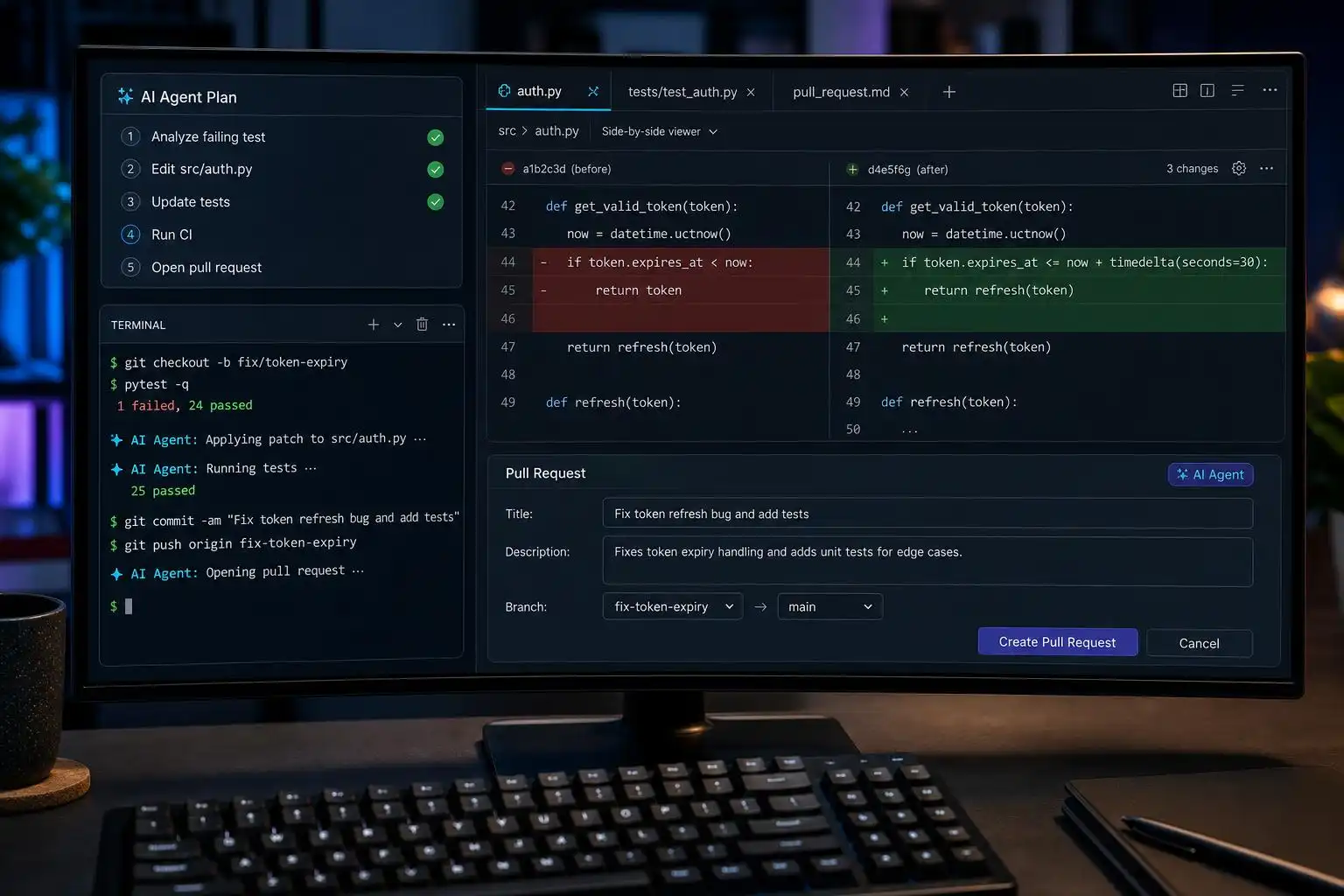

Six months ago, most teams still thought of “AI coding” as autocomplete plus chat. Today the leaders are shipping autonomous agents that read your repo, run commands, edit multiple files, and even open their own pull requests — and that shift is reshuffling the leaderboard inside IDEs and terminals alike.[1]
H2: What actually changed
AI coding moved from suggestion to execution. Vendors now emphasize end‑to‑end workflows (inspect → plan → edit → run → review → PR), with agents capable of orchestrating multi‑file refactors and CI‑aware fixes in one loop.[1] Benchmarks reflect the maturation: SWE‑bench scores cleared 80% at the top end, forcing a pivot to harder harnesses and real‑repo tests instead of toy snippets.[1]
On the business side, flat‑rate plans yielded to usage‑based billing, and adoption keeps rising — even as developer trust in raw outputs tightened guardrails and review loops.[1]
H2: Who’s winning (and for what)
If you’re picking a default agent today, here’s the short version grounded in recent comparisons and vendor defaults:
- Cursor: fastest “edit-in-place” workflow feel inside the IDE; mixes frontier models with its in‑house Composer.[1][3]
- Claude Code: strongest complex‑repo reasoning in terminals; ships on Opus 5 by default (since July 24, 2026).[1][3]
- GitHub Copilot: best value for mainstream IDE users via auto model selection, with higher‑tier models on Pro+/Max.[1][3]
- OpenAI Codex: tuned for larger delegated tasks; default “Power” maps to GPT‑5.6‑Sol (medium effort).[1][3]
- Gemini Code Assist/CLI: best fit if you’re deep in Google Cloud; Gemini 3.1 Pro tops its routing stack in recent scorecards.[1][3]
H2: Adoption flipped — and vendor lock‑in is the new risk
Multiple surveys and platform updates show a decisive shift: Claude Code is now the most widely adopted coding agent at work, with usage roughly double GitHub Copilot inside JetBrains IDEs’ AI chat — and JetBrains is leaning in with an ecosystem that treats agents as first‑class citizens via ACP, plus “Air” for multi‑agent workflows and “Central” for organization‑wide control.[2] JetBrains’ latest social update echoes the macro trend: 90% of developers now use coding agents weekly, Claude leads, and Codex is the fastest grower — with a clear warning that locking into a single vendor is risky when market share can flip in months.[5]
H2: Benchmarks and defaults you should actually care about
When you compare CLIs and terminals, check the model defaults and public harness results — not just IDE UX:
- Claude Code (v2.1.238) defaulting to Opus 5 sits around the top on Terminal‑Bench 2.1; Fable 5 posts ~80% on SWE‑Pro.[3]
- Codex CLI’s “Power: GPT‑5.6‑Sol” tier slightly edges the top Terminal‑Bench 2.1 slot in recent lists.[3]
- Gemini CLI/Antigravity route to Gemini 3.1 Pro at the top end; Copilot’s free tier stays auto‑selection, with premium tiers unlocking stronger models.[3]
- Open, model‑agnostic terminals like opencode are surging in stars and support MCP/LSP servers, sub‑agents, and BYOK (Ollama/LM Studio), which matters if you want to future‑proof your setup.[3]
H2: Cross‑agent skills are no longer optional
The community’s “agent‑rules” pattern has gone mainstream: shared skills and AGENTS.md rule sets now target multiple engines (Claude Code, Cursor, Codex, Windsurf) with domain kits for Jest, embedded STM32, and even technical‑docs style guides. That means you can install once and reuse across agents without rewriting prompts.[4] JetBrains’ ACP continues that story inside IDEs, letting teams plug agents in and out while keeping a consistent execution surface via Air and Central.[2]
H2: A vendor‑neutral harness you can ship this week
Here’s a minimal, durable setup I use to avoid lock‑in while taking advantage of the latest model bumps.
H3: 1) Centralize your operating rules (AGENTS.md)
Create AGENTS.md at the repo root with goals, guardrails, and skills. Keep it short, testable, and agent‑agnostic.
# AGENTS.md (excerpt)

## Project goals
- Reduce PR cycle time by 30% via agent-prepared diffs and test runs.
- Keep CI green: fail fast, propose fixes incrementally.

## Guardrails
- Never commit secrets. Redact .env and rotate creds on detection.
- For migrations: generate idempotent scripts; include rollback.
- Write tests first for bugfix tasks (Jest/Vitest patterns allowed).

## Skills
- jest-skill for async timers/snapshots; enforce CI-friendly patterns.
- refactor-rules: extract module, preserve public API, add changelog.

## Operating model
- Plan with file lists; propose patch sets <= 200 LOC each.
- Always run formatter and unit tests before proposing a PR.
You can source skills from the agent‑rules ecosystem (e.g., Jest rules, refactoring rulepacks) and keep them referenced here so all agents pick them up the same way.[4]
H3: 2) Switch agents without changing muscle memory
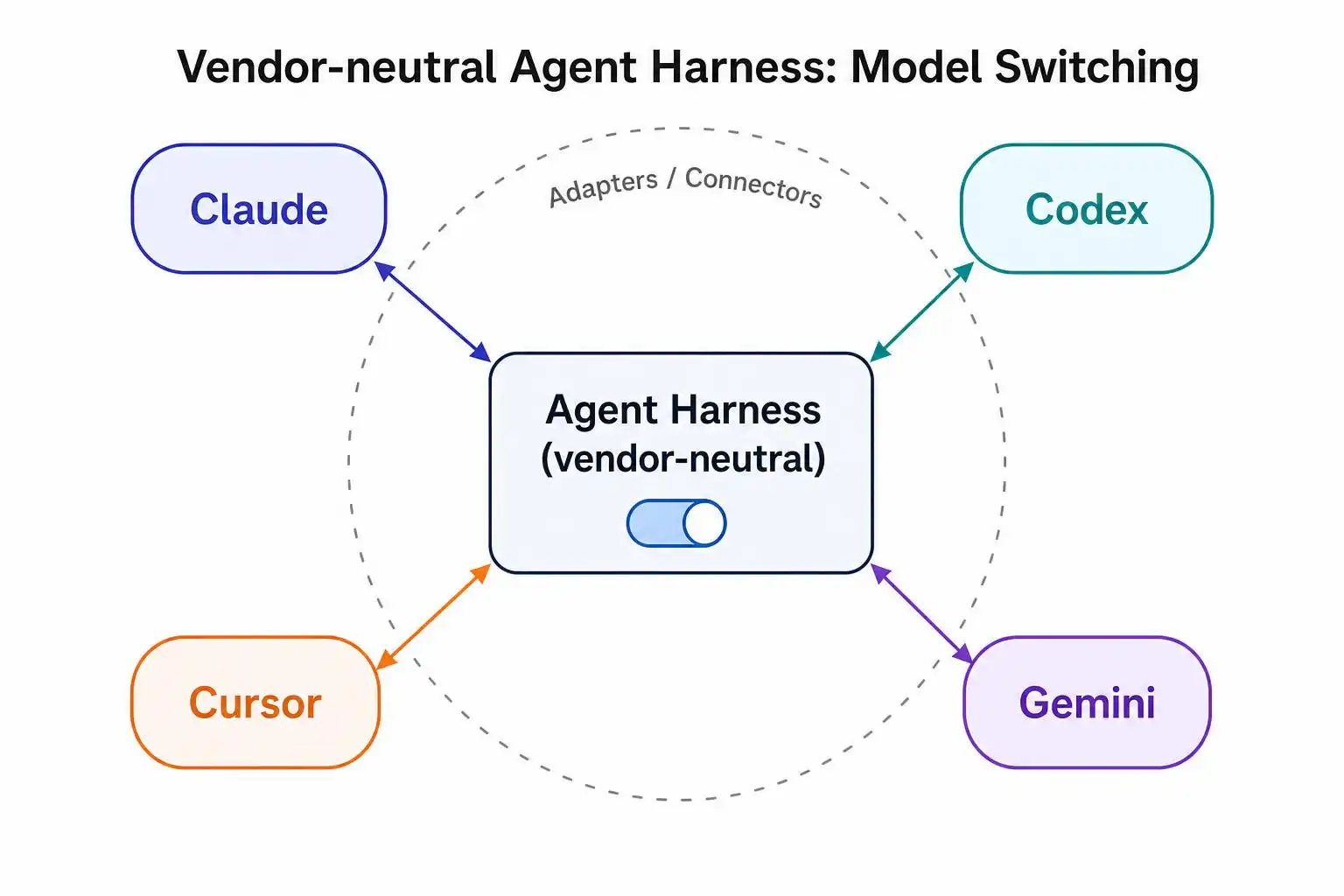
Wrap your favorite CLIs behind one function. Flip providers via an env var.
# ~/.bashrc or ~/.zshrc
export CODE_AGENT=${CODE_AGENT:-claude}

agent() {
  case "$CODE_AGENT" in
    claude)    claude-code "$@" ;;     # terminal app/CLI
    codex)     codex "$@" ;;            # OpenAI Codex CLI
    cursor)    cursor "--agent" "$@" ;; # invoke agent task
    gemini)    gemini "--code" "$@" ;;
    opencode)  opencode "$@" ;;
    *)         echo "Unknown agent: $CODE_AGENT" ; return 1 ;;
  esac
}

# usage: CODE_AGENT=codex agent fix tests/jest flaky timer
H3: 3) Keep providers pluggable (BYOK)
Whether you run opencode or an IDE plugin, treat LLMs as drivers you can hot‑swap.
// llm.providers.json (generic OpenAI-compatible examples)
{
  "providers": {
    "openai": {
      "baseURL": "https://api.openai.com/v1",
      "apiKeyEnv": "OPENAI_API_KEY",
      "model": "gpt-5.6-sol"
    },
    "anthropic": {
      "baseURL": "https://api.anthropic.com",
      "apiKeyEnv": "ANTHROPIC_API_KEY",
      "model": "opus-5"
    },
    "google": {
      "baseURL": "https://generativelanguage.googleapis.com",
      "apiKeyEnv": "GOOGLE_API_KEY",
      "model": "gemini-3.1-pro"
    }
  }
}
This lets you mirror the defaults you’ll encounter in current comparisons — Opus 5 for Claude Code, GPT‑5.6‑Sol for Codex, Gemini 3.1 Pro for Gemini CLI — without binding your workflow to a single vendor.[3]
H2: A quick buyer’s guide by scenario
- Terminal‑first, hard problems, large repos: start with Claude Code, keep Codex a toggle away for longer delegations.[1][3]
- IDE‑native speed with strong inline edits: Cursor, with Claude/Codex/Gemini routing as needed.[1][3]
- Microsoft stack or budget‑sensitive teams: Copilot’s value tiers; bring a terminal agent alongside for autonomy.[1][3]
- GCP‑heavy orgs: Gemini Code Assist/CLI plus ACP inside JetBrains for mix‑and‑match workflows.[1][2]
H2: The strategy shift for engineering leaders
The new default is a vendor‑neutral control plane: one set of rules and skills, multiple interchangeable agents, and an IDE that supports ACP so you can rotate models as prices, defaults, and benchmarks change. With 90% of developers using agents weekly and leadership positions flipping, the ability to switch without retraining your org is now a competitive advantage, not a nice‑to‑have.[5][2]
H2: Key takeaways
- Agents moved from autocomplete to autonomous code+PR loops; compare by workflows, not chat quality.[1]
- Claude leads enterprise adoption; Codex is growing fastest; don’t lock in.[5]
- Know the defaults: Opus 5 (Claude), GPT‑5.6‑Sol (Codex), Gemini 3.1 Pro (Gemini CLI).[3]
- Standardize AGENTS.md + shared skills; rely on ACP/agent‑rules to stay portable.[2][4]
- Build a switchable harness now so you can chase cost/perf without changing how you work.[5]
References
- AI Coding Assistants Compared: Cursor, Claude Code, GitHub Copilot, Codex, Gemini Code Assist | TechAmerica posted on the topic | LinkedIn — https://www.linkedin.com/posts/techamericaofficial_best-ai-coding-assistants-in-2026-top-tools-activity-7495665114357059585-lKn8
- AI Coding Agents: Adoption Trends — https://blog.jetbrains.com/research/2026/08/ai-coding-agent-adoption-2026
- Best AI Coding Agent (2026): Ranked by Terminal-Bench, Price, and Source — https://www.morphllm.com/ai-coding-agent
- agent-rules · GitHub Topics — https://github.com/topics/agent-rules
- Half a year ago, GitHub Copilot was the most widely used … — https://www.facebook.com/JetBrains/posts/half-a-year-ago-github-copilot-was-the-most-widely-used-ai-coding-tool-among-dev/1095171826171050


Leave a Reply