
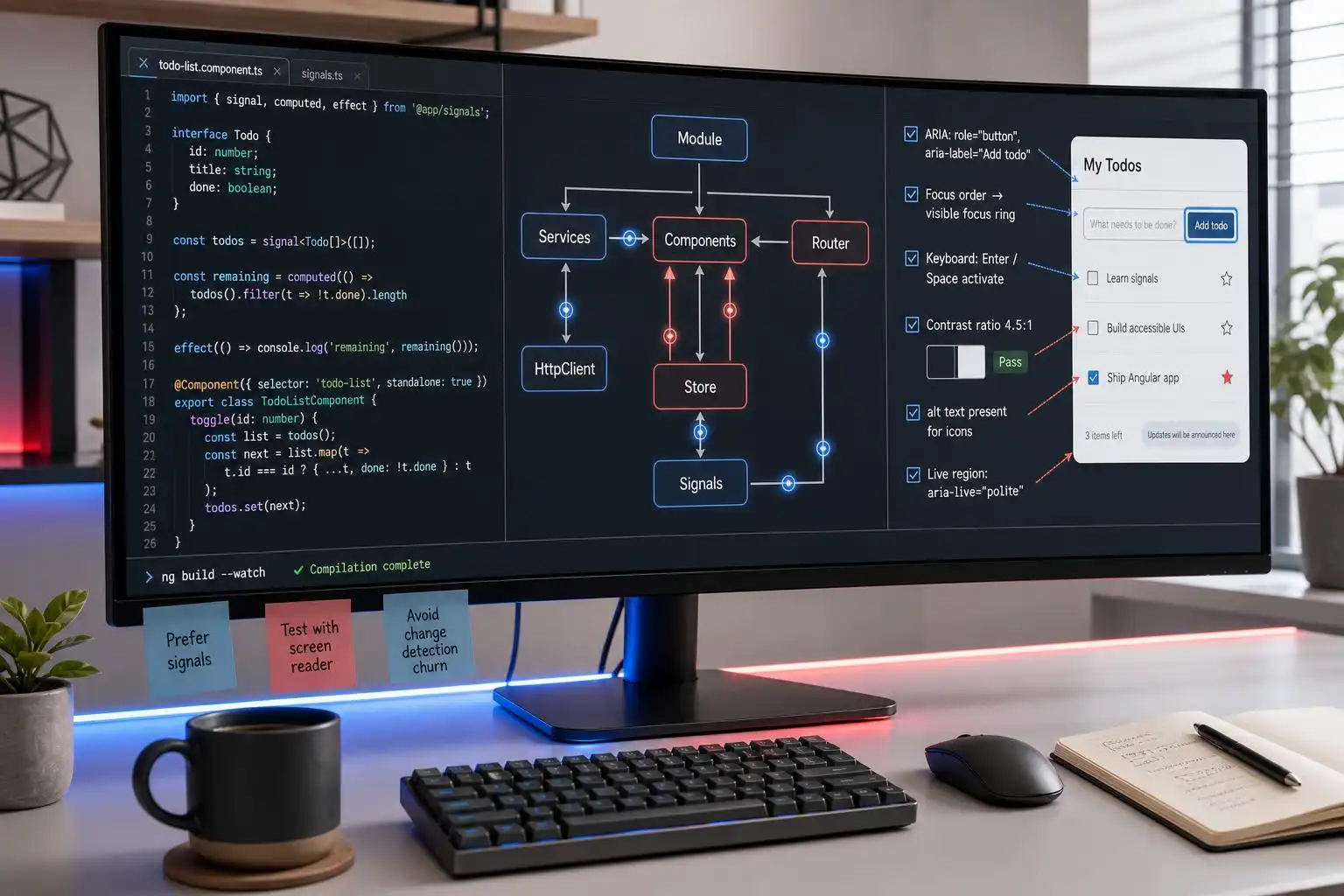

Angular’s 2026 story is not just “Signals are here” or “zoneless is faster.” The more interesting shift is architectural: Angular is increasingly opinionated about how large teams should build, test, upgrade, and maintain applications over years rather than weeks.
That matters because most Angular projects are not weekend prototypes. They are internal platforms, financial dashboards, healthcare portals, commerce systems, admin consoles, and multi-team products where consistency is a feature. Angular 22 leans into that identity with stable Signal Forms, stable Angular Aria, zoneless change detection by default for new projects, and a stable MCP server for tooling and AI-assisted workflows.[1]
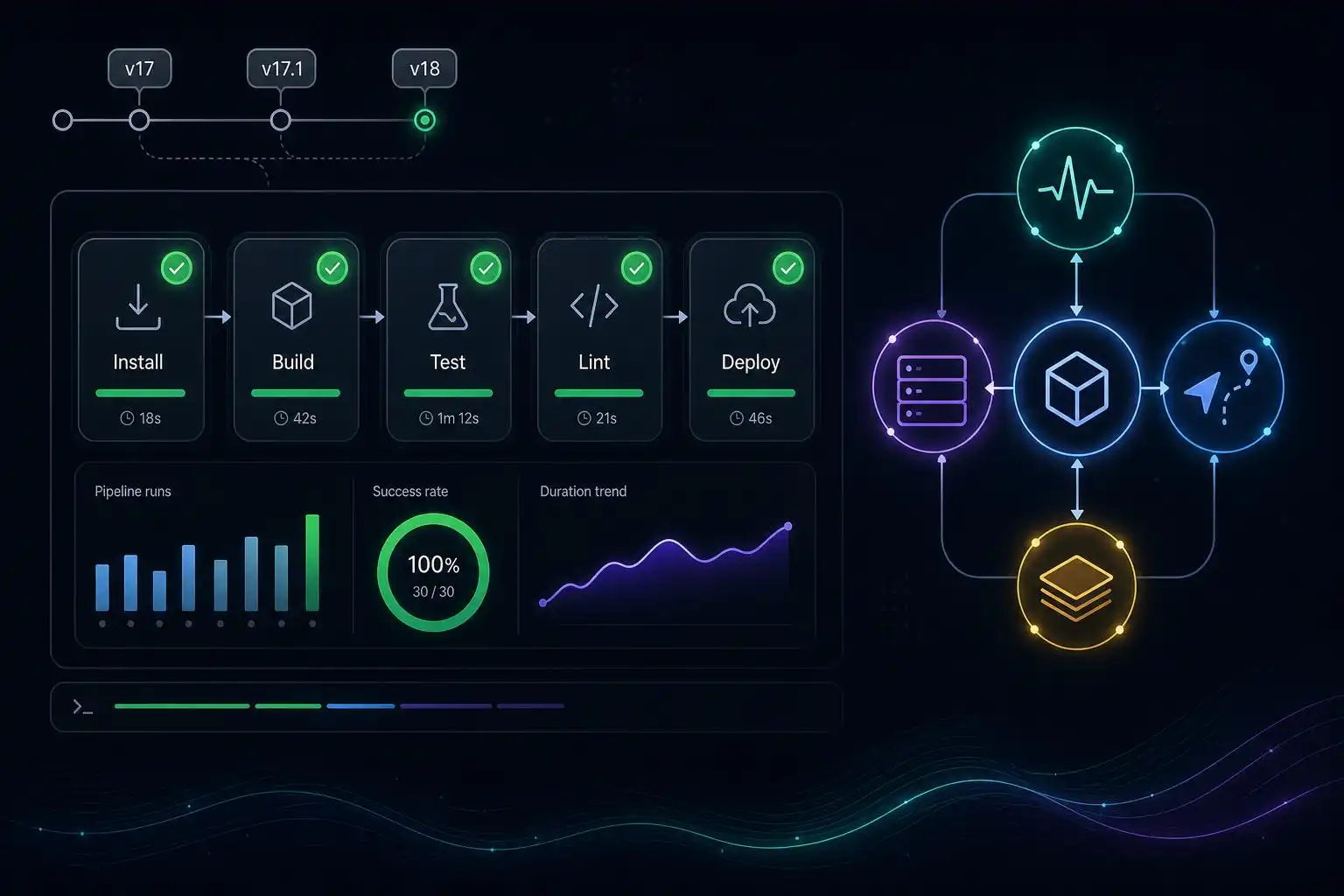
Angular 22 is less about novelty and more about defaults
For several years, Angular’s modernization path has been clear: standalone components, built-in control flow, Signals, deferrable views, improved SSR, and a gradual move away from Zone.js as the center of the change detection story.
Angular 22 feels like the point where many of those choices stop being “new architecture experiments” and become the expected baseline. If you create a new Angular application today, the conversation should start with:
- standalone-first application structure
- zoneless change detection
- Signals for local and derived state
- Signal Forms for form-heavy screens
- route-level lazy loading
- accessibility primitives through Angular Aria
- stricter TypeScript boundaries between features
- automated upgrade discipline
That last bullet is not glamorous, but it may be the most important one.
Angular’s ecosystem is powerful because the framework, CLI, Material/CDK, forms, router, compiler, and tooling all move together. The tradeoff is that teams must treat versioning as part of architecture, not as an afterthought.
Start with the runtime contract
One practical detail that is easy to overlook: Angular 22 has modern platform requirements. The reported requirements include Node.js v22.22.0+ or v24.13.1+ and TypeScript 6.[1] Whether your team is starting fresh or upgrading, lock this down before discussing folder structures or state management.
In real projects, I like to make the runtime contract visible in three places:
{
  "engines": {
    "node": ">=22.22.0"
  }
}
Then enforce it in CI, document it in the README, and make local development use the same version through your preferred version manager. Many “Angular upgrade problems” are actually environment drift problems wearing an Angular badge.
Signals are now an architectural boundary
Signals started as a reactive primitive, but in modern Angular they are becoming an architectural boundary. That means we should stop thinking of them only as a component-level convenience.
A good Signal-based design asks:
- Which state is local to the component?
- Which state is derived and should be represented as
computed()? - Which state belongs in a service?
- Which state is server-owned and should not be duplicated unnecessarily?
- Where do side effects belong?
My rule of thumb is simple: use Signals to make reads predictable and visible. Avoid using them to hide a global mutable object graph.
For example, a feature store service might expose readonly signals and keep writes behind named methods:
@Injectable({ providedIn: 'root' })
export class ProjectStore {
  private readonly _projects = signal<Project[]>([]);
  private readonly _selectedId = signal<string | null>(null);

  readonly projects = this._projects.asReadonly();
  readonly selectedId = this._selectedId.asReadonly();

  readonly selectedProject = computed(() => {
    const id = this._selectedId();
    return this._projects().find(project => project.id === id) ?? null;
  });

  selectProject(id: string): void {
    this._selectedId.set(id);
  }

  setProjects(projects: Project[]): void {
    this._projects.set(projects);
  }
}
That shape gives teams a clean API: components can read state easily, but writes remain intentional. In enterprise Angular, that is often more valuable than shaving a few lines from a component.
Signal Forms change how we model complex UI
Stable Signal Forms are one of the most important Angular 22 changes for teams building data-heavy software.[1] Forms are where frontend architecture usually gets messy: validation, async loading, disabled states, conditional fields, permissions, draft saving, localization, and error display all converge in one place.
The Angular Components release notes also show ecosystem alignment around Signal Forms, including CDK stepper support allowing a signal form to be assigned as stepControl.[2] That kind of detail matters. A forms model is only useful at scale if it works cleanly with the UI primitives teams already use.
For multi-step workflows, this means we can increasingly model form state as reactive state rather than as scattered subscriptions and imperative checks. The goal is not to eliminate every RxJS stream. RxJS remains excellent for async event streams. The goal is to avoid using subscriptions as glue for state that is fundamentally synchronous and view-facing.
Zoneless by default raises the quality bar
Zoneless Angular is a win, but it also removes a safety net. Zone.js made Angular forgiving: many async operations eventually triggered change detection even when the code was not especially deliberate.
With zoneless defaults in new Angular projects, teams need to be more explicit about how state changes reach the template.[1] Signals help here because a signal write gives Angular a clear notification path.
The practical advice:
- Prefer signal writes for view-facing state changes.
- Keep external callback APIs wrapped in framework-aware boundaries.
- Avoid mutating arrays and objects in place when the template depends on them.
- Use
computed()for derivations instead of recalculating in template methods. - Treat manual change detection calls as exceptions, not architecture.
In other words: zoneless Angular rewards code that already has clean state ownership.
Accessibility is moving closer to the framework core
Angular Aria reaching stability is another signal of where Angular is heading.[1] Accessibility cannot be something teams “sprinkle on” after the component library is finished. It needs to be part of the primitives.
The Angular Components changelog also continues to show accessibility and interaction refinements across Material, CDK, and Aria areas, including updates around radio behavior, sidenav inert handling, tabs validation, virtual scrolling, and selection utilities.[2]
These are not flashy headline features, but they are exactly the kind of improvements that matter in production UI. A sidenav with incorrect inert behavior or a virtual scroll that jumps unexpectedly can create real usability problems. Framework maturity often shows up in these small corrections.
The release cadence shift may be bigger than it looks
Angular has historically been predictable with major releases arriving twice a year. The reported move toward a yearly major release cadence, longer support windows, and more frequent minor releases changes how teams should plan upgrades.[3]
This is good news for organizations that need stability. Fewer major upgrades can mean less churn, easier roadmap planning, and more time for migrations to settle.
But there is a catch: longer support windows should not become an excuse to ignore maintenance. If anything, teams should become more disciplined about minor and patch updates. Smaller, regular upgrades are still safer than one giant annual scramble.
A healthy Angular upgrade policy might look like this:
- Patch updates: apply quickly after CI passes.
- Minor updates: schedule monthly or sprint-based review.
- Major updates: plan deliberately, but avoid skipping multiple majors.
- Material/CDK updates: test interaction-heavy components carefully.
- TypeScript and Node updates: validate in CI before local rollout.
The key is to make upgrades boring.
Do not confuse observed behavior with a contract
One of the best cautionary lessons from the current discussion is not even about Angular 22 specifically. It is the story of a small Angular 4 patch update that unexpectedly broke an application’s custom translation mechanism because the team had relied on observed DOM behavior rather than a guaranteed framework contract.[5]
That story still applies in 2026.
If your Angular architecture depends on private internals, DOM shapes produced by framework directives, undocumented timing behavior, or side effects from a third-party component, you do not have an architecture. You have a coincidence.
This is especially relevant now that AI agents and MCP-based tooling are entering the development workflow. AI can generate useful code quickly, but it can also generate code that “works” by leaning on accidental behavior. Senior engineers need to review not only whether code passes tests, but whether it depends on stable contracts.
The real 2026 challenge is complexity, not capability
Modern Angular has more capability than ever: Signals, standalone APIs, control flow, SSR improvements, deferrable views, Material/CDK, Aria, and better tooling. But that does not mean Angular development is automatically easier. Developers are also dealing with larger applications, distributed teams, AI features, aggressive performance expectations, and more complex state management problems.[4]
That is why architecture matters. Not architecture as a diagram in Confluence, but architecture as daily defaults:
- Where does state live?
- How does data enter a feature?
- How are forms validated?
- How are loading and error states represented?
- How are dependencies injected?
- What is allowed to be shared?
- What must stay private to a feature?
- How do we test upgrade-sensitive behavior?
Angular gives us excellent tools for these questions, but it does not answer them automatically.
My recommended Angular 22 feature structure
For most medium-to-large applications, I still prefer a feature-first structure:
src/app/
  core/
    auth/
    http/
    logging/
  shared/
    ui/
    pipes/
    directives/
  features/
    projects/
      data-access/
      ui/
      pages/
      projects.routes.ts
    billing/
      data-access/
      ui/
      pages/
      billing.routes.ts
A few guidelines make this structure work:
coreis for application-wide infrastructure, not random shared code.sharedshould contain boring, reusable, low-business-logic pieces.features/*/data-accessowns API calls and feature stores.features/*/uicontains presentational components.features/*/pagescoordinates routing, data loading, and composition.- Routes are the lazy-loading boundary.
This keeps Angular’s dependency injection hierarchy useful. It also prevents the common “shared folder landfill” problem where every abstraction goes to live forever.
What I would prioritize in a new Angular 22 project
If I were starting a serious Angular 22 application today, my initial checklist would be:
- Use the latest supported Node and TypeScript versions from day one.
- Keep the app standalone-first.
- Stay zoneless unless a dependency absolutely blocks it.
- Use Signals for local state and view-facing derived state.
- Use RxJS for async streams, cancellation, retries, and event pipelines.
- Use Signal Forms for new complex forms.
- Build accessibility into component design early.
- Add performance budgets before performance becomes a problem.
- Keep feature boundaries strict.
- Automate tests around critical user flows before dependency upgrades.
The important part is not adopting every new Angular feature immediately. The important part is choosing defaults that keep the codebase understandable two years from now.
Final thought
Angular 22 strengthens Angular’s position as a framework for long-lived, team-scale applications. The framework is faster, more reactive, more accessible, and more aligned with modern tooling than it was a few years ago. But the biggest benefit still comes from discipline: clear boundaries, explicit state, documented contracts, and boring upgrades.
That is the Angular architecture I trust most—not the cleverest one, but the one that survives the next patch update.
References
- Stop Risking Your Frontend: The Ultimate Angular 22 Architecture — https://medium.com/@contato.blense/stop-risking-your-frontend-the-ultimate-angular-22-architecture-c3460bf8b20a
- Releases · angular/components · GitHub — https://github.com/angular/components/releases
- Angular’s Biggest Release Schedule Change in Years Explained — https://medium.com/@Angular_With_Awais/angulars-biggest-release-schedule-change-in-years-explained-0dd1e017e51d
- Angular Development Challenges in 2026: Real Problems Developers Face and Practical Ways to Solve Them — https://medium.com/@roshannavale7/angular-development-challenges-in-2026-real-problems-developers-face-and-practical-ways-to-solve-64606e882e05
- It Was Just a Patch Update. What Could Possibly Go Wrong? – DEV Community — https://dev.to/sylwia-lask/it-was-just-a-patch-update-what-could-possibly-go-wrong-3be3


Leave a Reply