
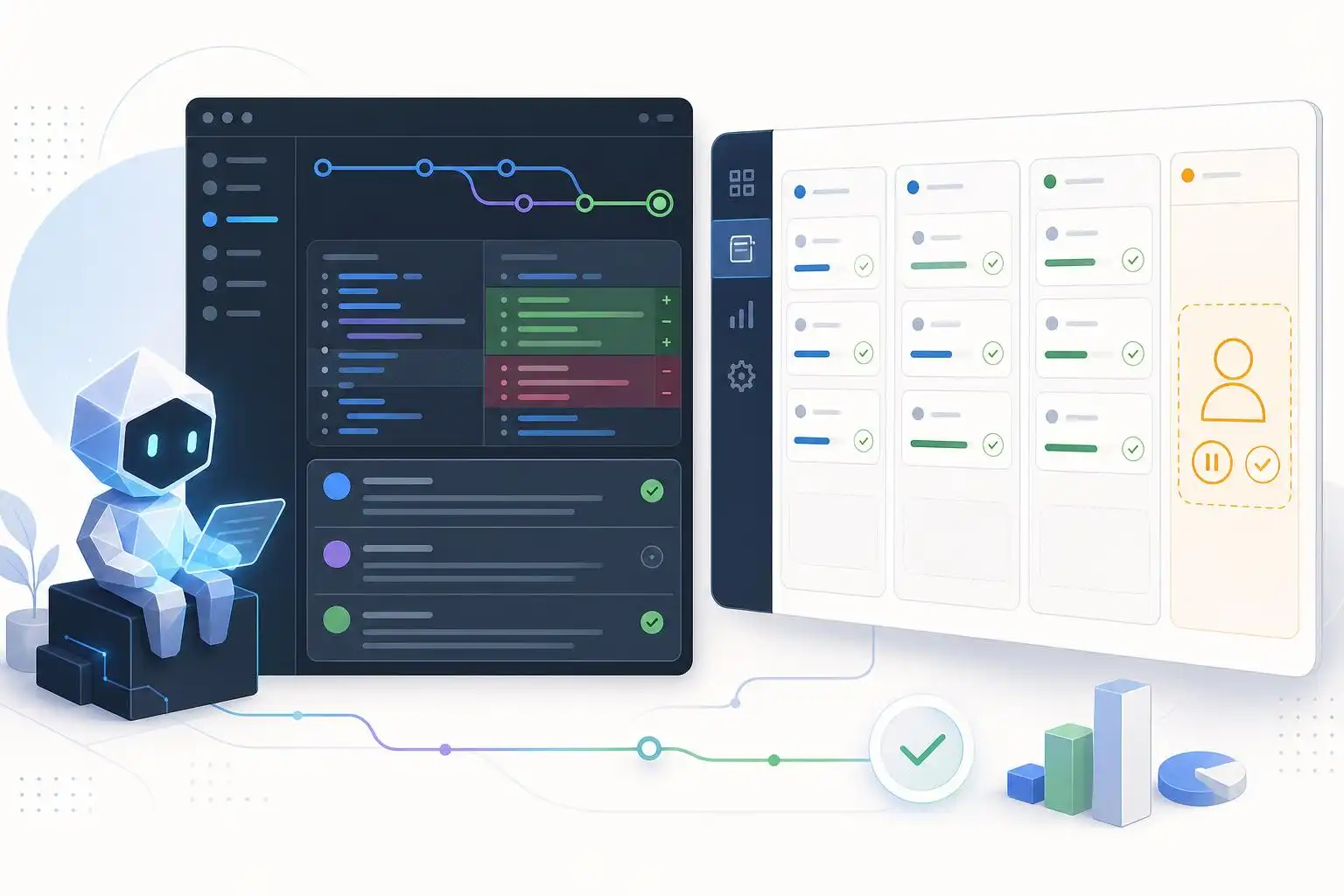

A coding agent finishes a fix, opens a pull request, and reports that the work is done. The tests passed in its workspace. The reviewer has not approved the PR. The deployment has not happened. Which of those facts should appear on the issue—and who gets to decide?
That question is becoming more useful than another coding-agent leaderboard. Agents are moving beyond code generation into issues, pull requests, project tools, and delivery workflows. GitHub Copilot, Claude Code, Codex, and other ecosystems are taking different routes toward that broader scope.[2] Once an agent can write back to the systems your team uses to track work, a plausible summary can become an operational mistake.

A code change and a status change have different owners
A PR shows what an agent changed. An issue status tells other people what they can rely on. “Implementation complete” might be accurate while “ready to ship” is not: CI could be failing, review could be pending, or the work could lack a required rollout plan. The agent may have enough context to draft an update without having the authority to make that decision.
This distinction is easy to miss when choosing a tool. A September comparison frames Codex, Copilot, Cursor, Google’s Antigravity CLI, and Kiro around different development environments and control preferences.[5] Those are useful buying criteria, but they do not answer whether a successful coding run should automatically change an issue’s status or a project’s risk assessment.
Pick the system of record before you automate it
A workflow vendor makes the complementary point: teams whose primary problem is keeping requirements, tasks, risks, and reviews synchronized may need a delivery platform rather than another IDE or terminal assistant.[1] That is a vendor’s recommendation, not evidence that its product is the right fit for every team. The underlying distinction is sound: writing code and maintaining shared delivery context are separate jobs.
For a small team, the GitHub issue and PR may be the system of record. For another, the authoritative state lives in a project platform, with GitHub providing implementation evidence. Choose one place for each consequential field. If “blocked” means something different in two tools, giving an agent permission to update both will not resolve the ambiguity—it will automate it.
Start with a draft update, not an autonomous transition
I would first let an agent assemble evidence and propose wording. In a GitHub-centered repository, a developer can collect the issue, changed files, and check results without granting the agent permission to change a workflow field:
ISSUE=123
PR=456

gh issue view "$ISSUE" --json title,body,state \
  --jq '{title,body,state}'
gh pr view "$PR" --json title,body,url,files \
  --jq '{title,body,url,files:[.files[].path]}'
gh pr checks "$PR"
The agent’s output should separate observations from conclusions. “PR #456 changes the authentication middleware” is evidence someone can verify. “Authentication is fixed” is a claim that may require tests and review. “Ready for release” is a workflow decision. Ask the agent to draft an issue comment with those categories labeled, then have a person check it before posting:
cat > status.md <<'EOF'
Proposed update for human review

Observed: PR #456 contains the proposed fix. Check results: verify
against the current PR before posting.
Pending: code review and release decision.
Suggested status: keep the issue open until those decisions are made.
EOF

cat status.md
# After review, post the comment deliberately:
gh issue comment "$ISSUE" --body-file status.md
That last command adds a comment; it does not change the issue’s status or prove the fix works. The example deliberately includes a verification placeholder. Replace it with current check results, or leave the check status explicitly unknown.
Grant write access one decision at a time
Once draft updates are consistently useful, expand permissions by consequence rather than by product capability. I would evaluate each proposed write-back against three questions:
- Evidence: Can a reviewer trace the statement to a specific PR, check, or decision?
- Authority: Is the agent allowed to post a comment, change a field, or close the issue?
- Recovery: Can the team spot and correct a wrong update before someone acts on it?
Comments are a sensible first write target because a reviewer can read the proposal in context. Closing an issue, changing an owner, or marking a milestone complete deserves a separate approval rule. If an agent cannot identify the authoritative record, it should report the ambiguity rather than guess. That is not a failure of autonomy; it is a useful boundary between producing evidence and declaring a business outcome.
Key takeaways
- Treat agent-written status as a claim to verify, not a by-product of a successful coding run.
- Decide which tool owns each workflow field before connecting agents to it.
- Start with evidence-backed draft comments; approve state transitions separately.
- Measure whether updates reduce coordination work without creating false confidence.
References
- Best Workflow Agents for Workflow Updates in 2026 — https://ones.com/blog/tool-guide/best-workflow-agents-for-workflow-updates-in-2026-2
- AI Agents in 2026: How Claude, ChatGPT, Copilot and Gemini Are Changing Work — https://levelup.gitconnected.com/ai-agents-in-2026-how-claude-chatgpt-copilot-and-gemini-are-changing-work-9db2b7f7c356
- 5 Best Claude Code Alternatives for 2026: Codex, Copilot and More — https://www.techrepublic.com/article/news-best-claude-code-alternatives-2026


Leave a Reply